0
0

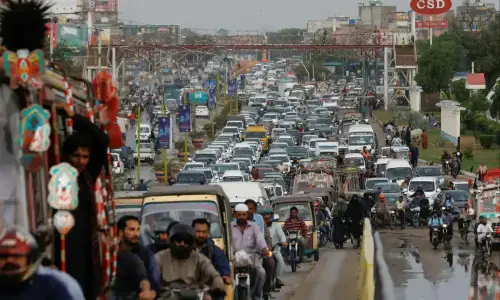
There was a spring of colours and ideas on the second day of the Lahore Literary Festival (LLF).
The colorful buntings were all over the venue. Book stalls and a food court were an attraction for the visitors.
In one of the sessions, titled ‘Chronicles from the Frontier Stations’ named after the book of Shakeel Durrani, a former civil servant, panelists Raheel Siddiqui and Khwaja Shamail discussed the book and the courage the writer had shown by writing down in a straightforward manner what he had seen and witnessed during his service tenure.
The book chronicles the author’s journey as a civil servant while serving at the highest levels in tribal areas, Gilgi Baltistan and Azad Kashmir.
Shakeel Durrani while elaborating that what the book was all about said it was not only a personal memoir but an inside view of many of the critical issues of governance and development which Pakistan faces and a reflection of Pakistan’s system of administration.
Khawja Shamail said Durrani through this book had shared his vision for the coming generations. The author had stated what had come in his way during his service without any reservation. The is an insider’s perspective, he added.
Syed Babar Ali who also attended the session and was sitting in the front row among the audience said he was happy to see Shakeel Durrani who had the courage to write such a thought-provoking book.
Raheel Siddiqui who moderated the session held the book in high esteem and said it had a lot to offer in terms of realities described by the author in his journey of civil service.
In another session, novel Dasht-e-Imkaan penned by playwright and educationist Asghar Nadeem Syed was launched. The session was moderated by Dr Muhammad Naeem. Mr Syed said the novel carried upsurging of many periods. “I had many stories to tell but in this novel I have streamlined all these stories in one link; it’s an old tradition of telling stories. This novel has a journey of stories,” said the author.
“The narrative of the story is based on facts as mostly the novel has my own personal experiences,” he added. He said a writer while writing in this part of world had to face political and religious taboos but one should know the way of saying things and he had tried to speak as much truth in this novel as he could.
In yet another interesting session titled. ‘Mainstreaming Museums’ moderated by Nadhra Khan, panelists Asma Ibrahim, Ghazaala Rehman and Jean-Baptiste Clais threw light on issues the museums face when it comes to their management.
Dr Asma Ibrahim, Director State Bank of Pakistan’s Museum, described her struggle and the kind of passion she had to come up with a museum that should be according to her dreams. “I put a lot of effort in establishing the SBP museum -- a museum I have always dreamt of,” said Ibrahim. She also shared with the audience how she maximised the experience of visiting museum by introducing wheel-chairs for the special visitors and braille for the visually impaired visitors.
“The SBP museum is a happening place where not only they hold summer camps for children, have a contemporary art gallery and artists residency programmes.”
Ghazaala Rehman, a pioneering furniture designer and convener on the Advisory Committee of Shakir Ali Museum, gave an introduction to Shakir Ali Museum and how she made an effort to bring the building out from a deep state of neglect. An advisory committee was formed to look into the affairs of the museum.
Shakir Ali Museum is also the regional office of the Pakistan National Council of Arts.
Rehman said Shakir Ali Museum was unique in its construction made of burnt brick. It was once the house of artist Shakir Ali. “We have plans to hold more and more cultural activities at the museum,” she added.
Jean-Baptiste Clais, the curator of Louvre Museum, threw light on the museum functioning and how it’s an iconic place. There is a good collection of artifacts there and visitors come in large numbers to this beautiful museum, said Clais.
In another session titled, ‘Untrodden Ways’ moderated by Wajiha Hyder, the panelists Tahir Jahangir, Salman Rashid and Zulfiqar Ali Kalhoro discussed their journeys of travelling and how some areas of Pakistan are less visited but those are extremely important sites to go both in terms of their historical significance and beauty.
The Sufi music lovers also enjoyed Qawali by Sami brothers.
Published in Dawn, March 20th, 2022