16
16

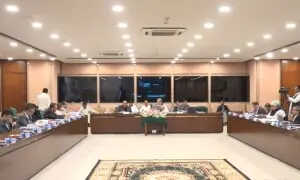
ISLAMABAD: Except the ruling Pakistan Tehreek-i-Insaf (PTI), all political parties, including government allies, in a consultative session with the Election Commission of Pakistan (ECP) on Tuesday opposed recent changes to the elections law to allow key public office holders to take part in election campaign.
Representatives of some 17 political parties attended the session with Chief Election Commissioner Sikandar Sultan Raja in the chair during which their opinion was sought on the draft code of conduct for the next general elections.
Informed sources told Dawn that most parties opposed the recent change to the code of conduct for polls through an ordinance. All political parties, except the ruling PTI, observed that key public office holders should be barred from taking part in election campaign.
The meeting was aimed at improving the draft code of conduct for the next general elections.
Representatives of 17 parties participate in consultation session with ECP
Minister of State for Information Farrukh Habib belonging to the PTI, Senator Taj Haider and Farhatullah Babar of the Pakistan Peoples Party and Zahid Hamid and Ahsan Iqbal of the Pakistan Muslim League-Nawaz were prominent among those who participated in the session.
Opinion of the participants was sought on the recently added Section 181-A to the Elections Act through a presidential ordinance. Section 181-A allows a member of parliament, provincial assembly or elected member of local government, including member holding any other office under the Constitution or any other law, to visit or address public meetings in “any area or constituency”.
The PTI representatives said the ECP should regulate the code of conduct keeping in view the presidential ordinance. They asserted that freedom of movement guaranteed under the Constitution could not be taken away from any citizen.
However, most of other political parties observed that lawmakers should not be allowed to visit areas where elections were to take place after the announcement of poll schedule.
While some smaller parties also suggested that ordinary members of the assemblies could be allowed to take part in poll campaign, representatives of majority of the political parties opposed the promulgation of the ordinance. They said that under Section 233 of the Elections Act, the code of conduct was required to be framed by the ECP in consultation with the political parties and that the government had no legal mandate to amend it through an ordinance.
Most of the political parties demanded restoration of a complete ban on participation of key public office holders, including the president, prime minister, governors, chief ministers, Senate chairman and deputy chairman, National Assembly speaker and deputy speaker and members of the federal and provincial cabinets, in the election campaign.
They were of the opinion that the controversial ordinance would be a hurdle in the way of conduct of free and fair elections.
A participant of the meeting quoted the CEC as saying that the ECP had already conveyed to the attorney general for Pakistan its concern over the controversial ordinance.
Consultative activities
Meanwhile, the CEC told an event held to mark International Women’s Day that the ECP in coordination with the stakeholders had arranged consultative activities at the national and provincial levels with an objective to get valuable suggestions to strengthen the role of women, persons with disabilities, minorities as well as transgender persons in the election process.
The CEC expressed the commission’s resolve to continue to play its constitutional and legal role in an appropriate manner. He said that all recommendations from such events and consultative sessions, particularly from civil society, women and the departments concerned would be of great value for the ECP to strengthen the democratic process.
Under Article 218(3) of the Constitution, he said, the ECP was responsible for holding independent, free, fair, transparent and impartial elections in the country. Under Article 25(2), he said, it was also ECP’s responsibility to ensure participation of all segments of society in the electoral process without any fear or threat and on an equal basis.
Published in Dawn, March 9th, 2022