Supreme Court disposes of Dr Abdul Qadeer Khan’s plea for being infructuous


 10
10

ISLAMABAD: More than four months after his death, the Supreme Court finally disposed of a plea instituted by nuclear scientist Dr Abdul Qadeer Khan seeking enforcement of his fundamental rights, including free movement.
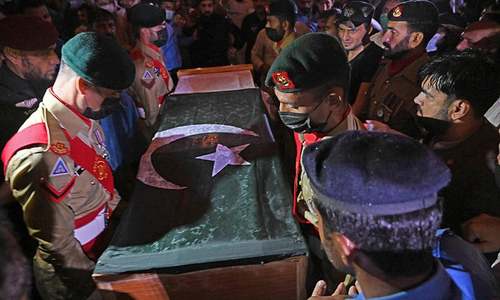
Regarded as “father of Pakistan’s nuclear bomb,” Dr Qadeer had breathed his last on Oct 10, 2021 at the age of 85 after being hospitalised with Covid-19.
A three-judge SC bench headed by Chief Justice Umar Ata Bandial disposed of the petition for becoming infructuous after the death of Dr Qadeer.
Advocate Taufiq Asif and Sheikh Ehsanuddin, representing Dr Qadeer, emphasised that Dr Qadeer was not an ordinary person and had rendered a great service to this nation but had to struggle for the realisation of his rights like Article 15 of the Constitution which ensures the freedom of movement.
The late scientist had sought enforcement of his fundamental rights, free movement
Advocate Asif said Dr Qadeer’s family should be vindicated by punishing those who imposed restrictions on his movement.
He regretted that the services of Dr Qadeer had not been recognised which was evident from the fact that the government had not named any major road or significant building after him.
The counsel also regretted that the scientist had been kept in virtual confinement in the name of security since 2004.
“Great nations always recognise and respect their heroes,” CJP Bandial observed, but suggested to the counsel to move a separate cause of action if he wanted to seek an appropriate court directive in this regard.
He recalled that in the last order the court had eulogised the services rendered by Dr Qadeer.
At the last hearing on June 23, the Supreme Court had asked Attorney General Khalid Jawed Khan to meet Dr Qadeer and allay his concerns after the top law officer said he had gone through the 2009 agreement before the Islamabad High Court and, therefore, he was extending an offer that the government was willing to facilitate the scientist but without prejudice to the consistent security interest involved in this matter.
The apex court had taken up Dr Qadeer’s appeal against the Sept 25, 2019 Lahore High Court judgement which had rejected his plea on the grounds that it lacked jurisdiction in view of the special security measures by the state.
Deciding Dr Qadeer’s habeas corpus petition on Feb 6, 2009, the IHC had declared him a free citizen and disposed of the petition in terms of Annexure-A, the content of which was not to be issued to the press or made public in any manner as requested by both sides.
On May 14, 2020, Dr Qadeer had claimed before the Supreme Court that he was forced to sign his consent in an earlier habeas corpus petition as a result of which the IHC had disposed of his case.
Dr Qadeer had claimed that the earlier consent letter was not of his free will and requested that his fundamental rights be safeguarded by the Supreme Court and given an opportunity to be heard.
In his appeal, Dr Qadeer had also explained that he was the pioneer of Pakistan’s nuclear programme and it was with the untiring efforts of the people at the helm of affairs that he succeeded in making the country a nuclear state and thus contributed to making it impregnable.
Dr Qadeer had bemoaned that he had no access to any friend so much so that his daughter or her children living a few houses away could not meet him, adding that so bad were the restraints that he even could not access the court.
Published in Dawn, February 25th, 2022