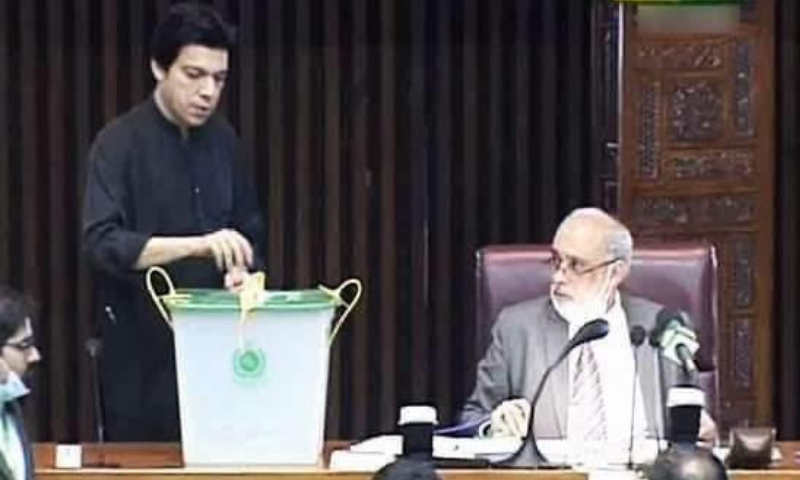
Faisal Vawda takes his disqualification case to Supreme Court


ISLAMABAD: Pakistan Tehreek-i-Insaf politician Faisal Vawda, who was disqualified for life from becoming a lawmaker, approached the Supreme Court on Friday with a plea to set aside the Election Commission of Pakistan’s (ECP) decision of Feb 9 that barred him from parliamentary politics.
Moved through senior counsel Waseem Sajjad, the former senator’s petition pleaded before the apex court that the ECP had given no grounds or reasons for invoking Article 62(1)(f) of the Constitution to disqualify him for life.
The ECP appeared to be under the impression that any person disqualified under Article 63(1)(c) of the Constitution (for having dual nationality) would automatically be penalised under Article 62(1)(f), the petition argued, adding that this was not right.
To incur a penalty under Article 62(1)(f) there must be ‘mens rea’ as well as evidence before a court of law, the petition contended, stating that both were missing in the ECP pronouncement.
The petition basically is an appeal against the Feb 16 rejection by the Islamabad High Court of his challenge to the ECP decision in which the high court had held that the commission was bound to give effect to the apex court’s declarations, and that was what it had done.
The appeal before the Supreme Court has named the ECP, Advocate Mian Asif Mehmood, Qadir Khan Mandokhel, Mian Muhammad Faisal and Dost Ali Jessar as respondents.
The petitioner had been disqualified for life from parliamentary politics through invoking of Article 62(1)(f) by the ECP, although it had been held by the Supreme Court in the 2021 Allah Dino Bhayo case that the commission was not a court of law within the context of Article 62(1)(f), said the petition.
The plea also said that in the Muhammad Sulman case, the Supreme Court had held that the ECP had no jurisdiction either under Article 218(3) of the Constitution or under Section 9(1) of the Elections Act, 2017 to deal with the matter of qualification or disqualification of a returned candidate.
Thus, the ECP order of Feb 9 clearly negated the assumption of jurisdiction by the commission to disqualify former senator Vawda for life, argued the petition.
The ECP had also ignored Article 225 of the Constitution under which no election to a house (of parliament) or the provincial assembly could be called in question except by an election petition presented to a tribunal, contended the plea.
The scheme of the Constitution is that the ECP makes arrangements for elections and is responsible for all the administrative acts during that process, but the electoral exercise comes to an end with the issuance of a notification through which a candidate is declared elected, according to the petition.
Therefore, after the judicial process takes over, only a tribunal could question the election and appeal lies before the apex court, the petition said. If the ECP’s contention was accepted, then Article 225 would become redundant.
Similarly, Section 9 of the elections act gives limited power to the ECP to exercise the powers of the tribunal for a period of 60 days and if the commission’s stance is accepted, there is no need to enact Section 9 because according to the ECP it has all the powers under Article 218 and Section 8(c).
It’s a settled principle of law that neither Article 225 nor Section 9 of the elections act can be ignored while interpreting the powers and functions of the ECP, the petition argued, adding that the language of the affidavit and its meaning needed to be seen in totality and with particular reference to the opening words which started with: “I hereby solemnly affirm and declare that to the best of my knowledge and belief…”.
“These opening words show that if a person honestly believes a certain thing particularly on a legal issue then he cannot be straightaway declared to be a guilty person if his belief runs contrary to a legal provision,” the petition contended. “Since the language of the affidavit is subjective and has penal consequences, therefore it must be construed strictly.”
The ECP should have taken into consideration the fact that the petitioner was not a lawyer and he believed a certain state of things on the basis of knowledge then available to him, added the petition.
Published in Dawn, February 19th, 2022