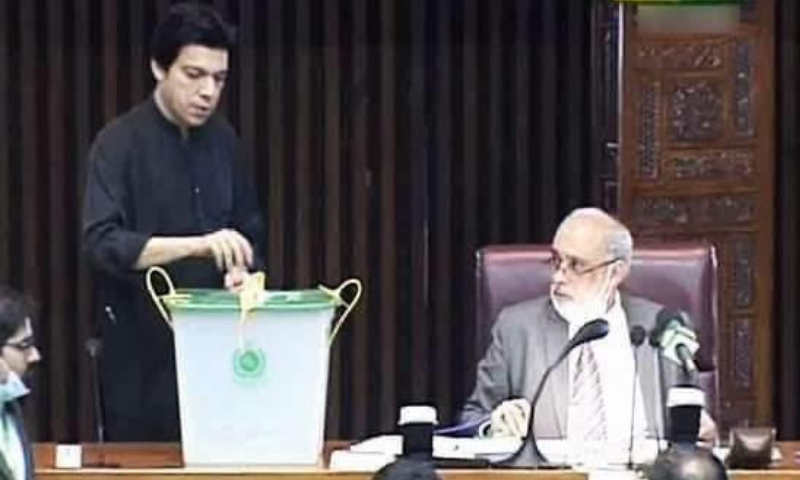
ISLAMABAD: Pakistan Tehreek-i-Insaf (PTI) leader Faisal Vawda on Tuesday filed an appeal before the Islamabad High Court (IHC) against his lifetime disqualification from parliament.
The petition argued that the Election Commission of Pakistan (ECP) lacked jurisdiction to invoke Article 62(1)(f) of the Constitution and to disqualify Mr Vawda for life since it was not a court of law.
IHC Chief Justice Athar Minallah will take up the petition on Wednesday (today).
An ECP bench, headed by the chief election commissioner, had disqualified Mr Vawda for concealing his US citizenship and directed him to return the salary and other benefits he had received as a minister and as a member of the National Assembly, within two months. It also de-notified him as senator.
Argues that Elections Act 2017 does not empower ECP to disqualify a candidate
While referring to the IHC order on his previous petition against the ECP proceedings, Mr Vawda stated in his appeal that the commission was directed by the court to “probe the issue of falsity or otherwise of the affidavit expeditiously as per a judgement of the Supreme Court”.
The apex court, in the Habib Akram case, had ruled: “If any false statement is made therein, it would also entail such penalty as is of filing a false affidavit before this [Supreme] Court.”
Mr Vawda claimed that the ECP was only required to probe the matter of the affidavit, arguing that the probe could not be used to confer the jurisdiction only a court possessed under Article 63 (1) (f) of the Constitution.
The PTI leader in his appeal stated that Section 8C of the Elections Act, 2017 allowed the ECP to conduct an election but did not empower it to disqualify a candidate. Also, he added, the Act gave limited power to the ECP to exercise the powers of a tribunal for a period of 60 days after the election of a constituency.
Mr Vawda secured the National Assembly seat (NA-249) in July 2018 general elections by narrowly defeating Pakistan Muslim League-Nawaz (PML-N) president Shehbaz Sharif. Two years later, a complaint filed before the ECP against his election stated that he was holding dual nationality at the time of filing the nomination papers. Subsequently, a petition seeking his disqualification was filed before the IHC. Mr Vawda frequently sought adjournments from the ECP and the IHC on different pretexts before finally resigning from the National Assembly’s seat in 2021.
The IHC did not disqualify him as he had already resigned from the assembly but warned of consequences for submitting false affidavit.
However, when Mr Vawda got elected as Senator last year, he faced another complaint of concealing his dual nationality in 2018. He then moved the IHC against the ECP proceedings.
Chief Justice Minallah who heard his petition then directed the ECP to conclude the proceedings on the complaint to ascertain as to whether the lawmaker was a dual national at the time of filing of nomination papers.
Justice Minallah had dismissed his petition on Nov 12 while allowing the ECP to proceed against the PTI senator.
In the Nov 12 order, the IHC chief justice observed that if the ECP found anomalies in Mr Vawda’s declaration, he might be proceeded against for contempt of court, as a five-member SC bench had declared that filing a fake affidavit before the returning officer would be contemptuous and besides disqualification it would entail penal consequences.
Published in Dawn, February 16th, 2022