North Korea tests most powerful missile since 2017



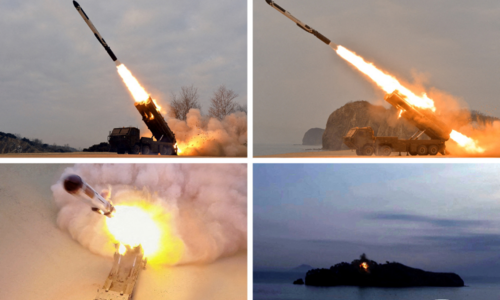
SEOUL: North Korea on Sunday tested its most powerful missile since 2017, ramping up the firepower for its record-breaking seventh launch this month as Seoul warned nuclear and long-range tests could be next.
Pyongyang has never test-fired this many missiles in a calendar month before and last week threatened to abandon a nearly five-year-long self-imposed moratorium on testing long-range and nuclear weapons, blaming US “hostile” policy for forcing its hand.
With peace talks with Washington stalled, North Korea has doubled down on leader Kim Jong Un’s vow to modernise the regime’s armed forces, flexing Pyongyang’s military muscles despite biting international sanctions.
South Korea said on Sunday that North Korea appeared to be following a “similar pattern” to 2017 — when tensions were last at breaking point on the peninsula — warning Pyongyang could soon restart nuclear and intercontinental missile tests.
North Korea “has come close to destroying the moratorium declaration”, South Korea’s President Moon Jae-in said in a statement following an emergency meeting of Seoul’s National Security Council.
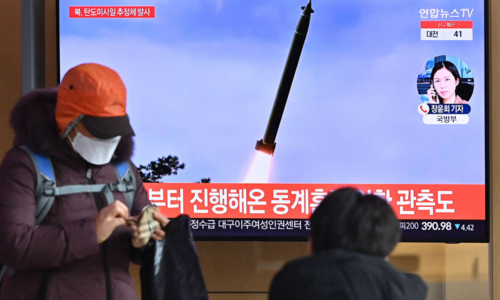
South Korea’s military said on Sunday it had “detected an intermediate-range ballistic missile fired at a lofted angle eastward towards the East Sea”.
The missile was estimated to have hit a maximum altitude of 2,000 kilometres and flown around 800km for half an hour, Seoul’s Joint Chiefs of Staff said.
A lofted trajectory involves missiles being fired at a high angle instead of out to their full range.
“North Korea did similar tests with its emerging medium and long range missile technology in 2017,” tweeted Chad O’Carroll of specialist website NK News.
“So this would imply today’s test involves one of those missile types — or potentially something new. In other words, a big deal.”
The last time Pyongyang tested an intermediate-range missile was the Hwasong-12 in 2017, which analysts said at the time was powerful enough to put the US territory of Guam in range.
Japan’s top government spokesman Hirokazu Matsuno said on Sunday that the ballistic missile “was one with intermediate-range or longer range”.
The United States condemned the launch, with a State Department spokesperson saying it was a “clear violation” of multiple UN Security Council resolutions.
Linda Thomas-Greenfield, the US ambassador to the United Nations, told ABC’s “This Week” programme the launch was “provocative”, adding the US was “absolutely open to a diplomatic engagement without preconditions”.
“Our goal is to end the threatening actions that the DPRK is taking against their neighbours,” she said.
Pyongyang has tested hypersonic missiles twice this month, as well as carried out four launches of short-range ballistic and cruise missiles.
Washington imposed fresh sanctions over the tests, prompting Pyongyang to vow a “stronger and certain” response to any attempt to rein it in.
Last week, leader Kim was photographed by state media inspecting an “important” munitions factory that produces “a major weapon system”.
“Kim has been withholding his appetite for testing and provocations,” Soo Kim, an analyst at the RAND Corporation, said.
Now, however, “the time is ripe, and North Korea’s continued missile firing will only throw another wrench into Washington’s already high plate of foreign policy challenges”, she added.
The frenzy of missiles aims to remind the world that “the Kim regime hears external discussions of its domestic weaknesses”, said Leif-Eric Easley, a professor at Ewha University.
“It wants to remind Washington and Seoul that trying to topple it would be too costly.”
The string of launches in 2022 comes at a delicate time in the region, with Kim’s sole major ally China set to host the Winter Olympics next month and South Korea gearing up for a presidential election in March.
Domestically, North Korea is preparing to celebrate the 80th anniversary of the birth of late leader Kim Jong Il in February, as well as the 110th birthday of founder Kim Il Sung in April.
Published in Dawn, January 31st, 2022