The National Security Policy has elicited a wide spectrum of responses from the business community


 1
1


ADVISING the formulators rather politely to broaden the ownership of the new security policy by taking all political parties on board, big business in Pakistan believes placing the economy at the core of the security doctrine can generate the much-needed thrust for growth and sustainable development.
A tier below, the local chambers, representing medium-scale businesses and traders, seem to resent their exclusion from the consultative process that spanned multiple years before the finalisation of the National Security Policy (NSP).
On its part, the micro-segment, mostly comprising unregistered entities, finds itself too overwhelmed by survival challenges to care about what it considers a remote development with no direct bearing on it or its future.
Experts on the two extremes of the political spectrum either hail the new security policy as a ‘game-changer’ or dismiss it as ‘juvenile and contradictory’. Those in the middle describe the document variably as ‘comprehensive’, ‘verbose’, ‘repetitive’ and ‘wishful’. Leaders of opposition parties, when contacted, were reluctant to express their opinion on record without clarifying if they had been so advised by their respective parties or they themselves preferred it that way.
The National Security Policy has elicited a wide spectrum of responses from the business community
Ehsan Malik, CEO of the Pakistan Business Council (PBC), the elite forum of the country’s most successful companies, believes that the section on the economy in NSP was informed by PBC’s agenda. “Placing economic stability and growth as the centre-piece of national security is a welcome step. The PBC was consulted on the importance of employment creation, value-added exports, import substitution and the need to formalise the economy by broadening the tax base. These are the pillars of PBC’s ‘Make-in-Pakistan’ thrust. It is pleasing to see them incorporated in the NSP”.
Talking to Dawn, he also mentioned the recent PBC event in Islamabad where the elements of economic security were discussed with government representatives and development partners. “We stressed the need for all the parties to adopt a Charter of Economy for socio-economic development. Pakistan lags behind others in South Asia in virtually all key measures. We hope that the NSP will get a cross-party buy-in.”
The Overseas Investors Chamber of Commerce and Industry is said to be deliberating on the contents of NSP and its implications before formally taking a position. Secretary-General M. Abdul Aleem, on his part, was impressed by the concept of economic security that he thought in this day and age was essential besides territorial security. “We are pleased that NSP highlights the need for sustainable and consistent economic policies for investment in intellectual capital and innovation which is linked to our focus on intellectual property rights in Pakistan.
“We hope that it will lead to fresh thinking in the relevant forums on regional trade, greater integration with the global economy and more interaction at international forums”.
He praised comprehensive identification of the key segments for improving agricultural and industrial productivity going forward to leverage the economic potential of Pakistan by focussing on technical education and artificial intelligence (AI). In his opinion, NSP will boost the confidence of the existing and potential foreign investors.
Several representatives of local chambers lamented about not having been consulted. “No, we were not in the loop during the formulation process and need time to discuss the matter in our circles to understand what the NSP means for us,” a former president of the Federation of Pakistan Chamber of Commerce and Industry (FPCCI) responded rather bitterly to Dawn’s request for comments.
Majyd Aziz, former president of the Employers Federation, was happy with what he termed a ‘holistic approach’. However, he was a little sceptical over its execution. “The litmus test will be NSP’s implementation. A mechanism has to be evolved to track, monitor and evaluate the progress, or the good work will be lost. There is a need to revisit the current economic policies to align them with the NSP.”
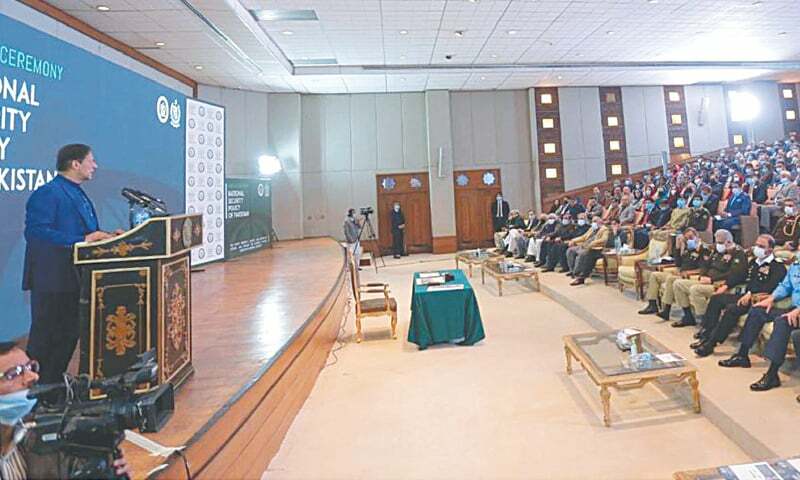
Earlier this month, NSP 2022-26 was announced. The 48-page document seems to be based on the vision of Chief of Army Staff General Qamar Bajwa’s that he had shared soon after assuming the command back in 2017.
At a seminar jointly organised by the Inter-Services Public Relation (ISPR) and the FPCCI in Karachi, he had spoken about setting economic priorities straight and had hammered the need to broaden the tax base, establish fiscal discipline and ensure consistency in economic policies.
He had informed the audience, which comprised, among others, top-tier business and military leadership, that the national economy had always been high on the agenda of the National Security Council (NSC) meetings.
The NSP, which claims to be citizen-centric, has not included priority actions and implementation framework and has cited reasons for the exclusion.
The policy merges what it calls traditional (defence, territorial integrity, internal security and foreign policy) and non-traditional (economic health and citizen’s wellbeing) elements. It states: “The ultimate purpose of national security must be to ensure citizens’ safety, security, dignity and prosperity. The national security framework presented in this document conceptualises the elements of policy necessary to achieve … The country’s security imperatives in the next decade will be driven by the need to realise its economic potential while ensuring national cohesion, territorial integrity, internal security and citizen welfare.”
Its vision is to “… keep economic security at the core, and judiciously transfer the dividends of a strong economy to further strengthen our defence and human security”.
A political observer critical of the NSP believed that the policy was explicitly about giving a fresh orientation to all sectors of the economy and segments of social life in the country “to better serve the security establishment”. He challenged the legality of a key policy drafted without parliamentary oversight in a democratic system.
Expressing doubts over claims of public consultation, he drew attention toward the exclusion of the Pakistan Institute of Development Economics (PIDE), the premier economic research body of the government, from the entire process.
Published in Dawn, The Business and Finance Weekly, January 24th, 2022