US, Russia hold talks amid tensions linked to Ukraine


GENEVA: Senior US and Russian officials launched special talks on Monday aimed at defusing tensions over a Russian military buildup on the border with Ukraine, part of a flurry of diplomatic activity in Europe this week.
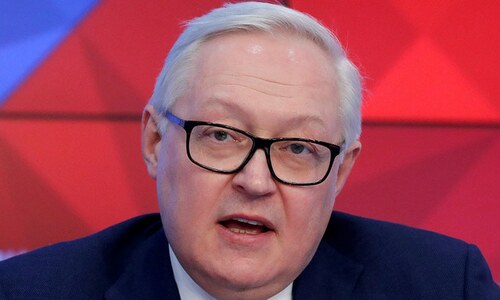
Russian Deputy Foreign Minister Sergei Ryabkov and his delegation arrived under Swiss police escort at the US diplomatic mission in Geneva for face-to-face talks with Wendy Sherman, the US deputy secretary of state, and her team. The meeting is part of Strategic Security Dialogue talks on arms control and other broad issues launched by Presidents Joe Biden and Vladimir Putin during a June summit in the Swiss city. No major breakthrough was immediately in sight.
After an informal working dinner on Sunday, Ryabkov predicted difficult talks in Geneva that are to be followed by a Nato-Russia meeting in Brussels on Wednesday and a meeting Thursday in Vienna of the multilateral Organisation for Security and Cooperation in Europe.
Moscow has sought to wrest a string of concessions from the US and its Western allies, including guarantees that Nato will no longer expand eastward into former Soviet states like Ukraine, along whose border Russia has massed an estimated 100,000 troops in steps that have raised concerns about a possible military intervention there.
Sherman stressed the United States commitment to the international principles of sovereignty, territorial integrity and the freedom of sovereign nations to choose their own alliances at the dinner, said State Department spokesman Ned Price, a reference to Ukraine and its aspirations of joining Nato. Many analysts say any such move would be years away at best.
Sherman affirmed that the United States would welcome genuine progress through diplomacy, Price said.
The US has played down hopes of significant progress this week and said some demands like a possible halt to Nato expansion go against countries’ sovereign rights to set up their own security arrangements, and are thus non-negotiable.
But US officials have expressed openness to other ideas, like curtailing possible future deployments of offensive missiles in Ukraine and putting limits on American and Nato military exercises in Eastern Europe if Russia is willing to back off on Ukraine.
US Secretary of State Antony Blinken said bluntly that he doesn’t expect any breakthroughs in the coming week. Instead, he said a more likely positive outcome would be an agreement to de-escalate tensions in the short term and return to talks at an appropriate time in the future. But the US will have to see a de-escalation for there to be actual progress.
Its very hard to see that happening when there’s an ongoing escalation, when Russia has a gun to the head of Ukraine with 100,000 troops near its borders, the possibility of doubling that on very short order, Blinken said on ABCs This Week. Nato Secretary General Jens Stoltenberg also sought to play down expectations.
I don’t think that we can expect that these meetings will solve all the issues,” he told reporters in Brussels on Monday after talks with Olga Stefanishyna, Ukraine’s deputy prime minister for European and Euro-Atlantic Integration. “What we are hoping for is that we can agree on a way forward, that we can agree on a series of meetings, that we can agree on a process.
Speaking to reporters during a visit to Rome, German Foreign Minister Annalena Baerbock said dialogue offered the only way out of the crisis.
At the same time, its equally clear that a renewed breach of Ukrainian sovereignty by Russia would have grave consequences, she said.
Russia has said it wants the issue resolved this month, but Nato is wary that Putin might be looking for a pretext, such as a failure in the negotiations, to launch an invasion.
The United States, which has emphasized that Ukraine’s government and those of other European countries need to be included in the discussions, plans to discuss some bilateral issues in Geneva but will not discuss European security without our European allies and partners, Price said.
Russia entered the talks seeking a clearer understanding of the US position and cited signals from Washington that some of the Russian proposals can be discussed, Ryabkov said, according to state news agency Tass on Sunday.
Ryabkov laid out Russia’s three demands: no further Nato expansion, no missiles on Russia’s borders, and for Nato no longer to have military exercises, intelligence operations or infrastructure outside of its 1997 borders.
Published in Dawn, January 11th, 2022