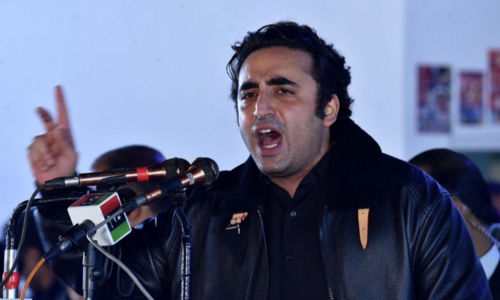
WASHINGTON: “Benazir Bhutto’s son would like to continue her legacy but how far he has the autonomy to do so” is not clear, says historian Dr Ayesha Jalal.
Dr Jalal, a leading historian of Pakistan and South Asia, was the main speaker at a virtual seminar on the slain Pakistani prime minister where speakers argued that only an independent political system could bring the country out of its troubles.
At another seminar, also held in Washington this week, Kamran Rizvi, Benazir Bhutto’s adviser on human rights, condemned the trend of branding opposition politicians as traitors and urged all political forces to work together to restore unfettered democracy.
“Her legacy is unfolding as we speak, her son would like to continue that legacy but how far he has the autonomy to do so before a combination of factors both within the party and without,” was not clear yet, Dr Jalal said. She urged PPP to discuss how to revive BB’s legacy and provide people with an alternative to the current system, which had failed to deliver.
Mr Rizvi urged all political parties to work together to stem out those who were “spreading religious intolerance and hate.”
“Everybody is playing politics, and this is addictive,” said Dr Jalal while underlining the difference between BB and other politicians. “Things could have been different if BB were around.
She had a conscience,” she said, adding that “something has to be done” now to continue BB’s legacy.
“We have seen a decline in the very conception of governance. And it has been replaced with formative politics where pretense replaces considered policy and careful implementation so long as it is couched in the language of religion,” she argued.
Dr Jalal noted that Benazir Bhutto also had to make compromises, but she was also “the first to acknowledge that her hands were tied.”
BB did “not abandon her conscience when she saw injustice and felt the need to take a strong moral stance, she did,” Dr Jalal said. “With her gone, it is rare to find anyone asking questions that must be asked of public servants, elected or non-elected.”
She explained how “lynching by emotionally charge vigilante mobs” had become the norm “while the rulers play politics, much as Nero fiddled while Rome burnt.”
Dr Jalal noted that BB’s hands were tied on a range of issues, but she was always willing to create alternative spaces to try and achieve her goal. “She had an acute sense of history and history eventually will have to judge her.”
Mushtaq Rajpar of the Friends of Sindh Society, Washington, who organised the seminar, said it was important to recall BB’s achievements and sacrifices to restore true democracy in the country.
Another speaker, Iqbal Tareen, said that BB had a stabilising influence on Pakistani politics and urged political forces to unite under the banner of democracy.
Another scholar and author Dr Ayesha Siddiqa recalled how BB returned to a country paralysed by Zia’s martial and revived democracy. She argued that like other political murders, BB’s murder “will also remain mystery” but her sacrifice would continue to encourage political struggles.
Senator Afrasiab Khattak said that BB understood the weakness of Pakistan’s political forces, reached out to other parties and played a key role in the MRD movement.
“She also reached out to powers other than the US” and appealed directly to political forces in both the United States and Europe to help restore democracy in Pakistan, he said.
“We are now living in the post-Zia Pakistan with controlled democracy, censorship, curbed rights, disappearances and terrorism,” which had further increased the need for a united struggle, Mr Khattak said.
Kamran Shafi, a former ambassador and journalist who was a member of BB’s first government as well, also emphasised the need for a united front for restoring democracy.
Hasan Mujtaba, a New York-based Pakistani poet, recited his famous poem on Benazir Bhutto, which was also printed on her daughter’s dupatta during her wedding ceremonies.
Published in Dawn, December 29th, 2021