US notes Islamabad’s efforts to meet FATF demands


 23
23

WASHINGTON: The annual US report on terrorism acknowledged on Thursday that Pakistan took steps in 2020 to counter terrorism financing, restrain India-focused militant groups and to meet demands of the Financial Action Task Force (FATF).
Pakistan continued to experience terrorist attacks last year, said the report. Pakistani military and security forces undertook counterterrorism operations against groups that conducted attacks within Pakistan, such as the banned Tehreek-i-Taliban Pakistan (TTP), the militant Islamic State (IS) group and Balochistan Liberation Army.
“Pakistan took steps in 2020 to counter terror financing and restrain India-focused militant groups from conducting attacks. Pakistan convicted Lashkar-e-Taiba (LeT) founder Hafiz Saeed and four other senior LeT leaders in multiple terrorism financing cases,” the report said.
Although the report acknowledged Pakistan’s efforts to counter terrorism, it claimed that groups targeting Afghanistan and India — such as the Haqqani Network, LeT, and Jaish-e-Mohammed (JeM) — continued to operate from Pakistani territory.
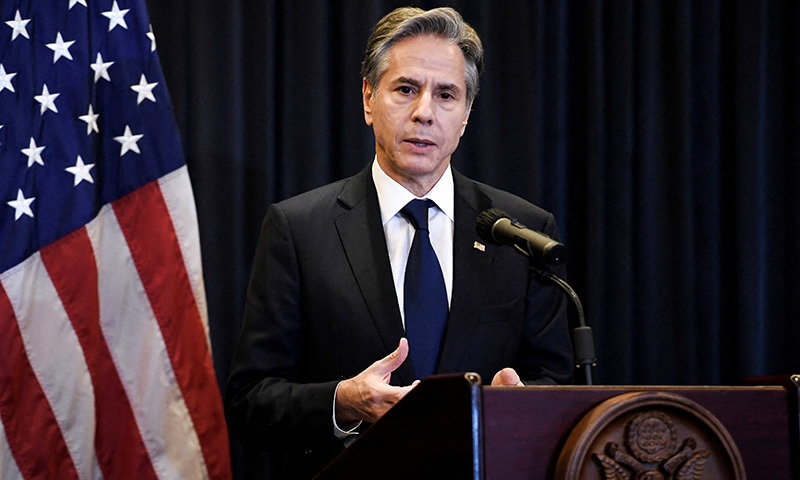
Secretary of State Antony Blinken releases report in Washington
“Pakistan did not take action against other known terrorists such as JeM founder and UN-designated terrorist Masood Azhar and 2008 Mumbai attack ‘project manager’ Sajid Mir, both of whom are believed to remain free in Pakistan,” the report added.
But it also acknowledged that “Pakistan did make positive contributions to the Afghanistan peace process, such as encouraging Taliban reductions in violence”.
Noting Pakistan’s efforts to meet the demands put forth by FATF, the report noted: “Pakistan made additional progress in 2020 toward completing its FATF Action Plan, but did not complete all Action Plan items and remained on the FATF ‘grey list’.”
In a separate chapter titled “Support for Pakistan”, the report said the US government recognised Pakistan’s role in Afghanistan and broader regional security, and “urges Pakistan to dismantle terrorist groups within its territory”.
It pointed out that the United States “cooperates with Pakistan on counterterrorism operations, which has helped Pakistan reclaim parts of the country previously held by militant groups”.
Yet, TTP and other designated terrorist groups “continue to conduct attacks against Pakistani military and civilian targets”, said the report, adding that “while Pakistan has taken some action against these designated terrorist organisations, some externally focused terrorist groups continue to find safe haven in Pakistan”.
That’s why “the US government continues to suspend most of its security assistance to Pakistan. That suspension remained in effect throughout 2020”, said the report.
Despite the restriction, however, the US government maintained a civilian assistance portfolio on a focused set of priorities, the report added. “Civilian assistance continued to prioritise civil society; people-to-people exchanges; stabilisation and development on the Afghanistan-Pakistan border; trade and economic growth,
including partnering with US businesses; law enforcement, counterterrorism.”
The counterterrorism efforts included countering terrorist financing and related anti-money laundering, nonproliferation cooperation; and polio and other infectious diseases, including Covid-19.
The report explained that the emphasis of US civilian assistance to Pakistan remained on sustainable development and capacity-building, and on leveraging trade and private sector investment, where possible.
It also encouraged partnership and a long-term positive impact for the Pakistani people.
People-to-people exchanges, which largely shifted to virtual exchanges during Covid-19, help promote mutual understanding and bilateral ties.
“The United States supported civilian law enforcement and the rule of law to help Pakistan disrupt transnational organised crime and terrorist networks and provide security and justice for Pakistani citizens,” the report added.
US Secretary of State Antony Blinken, who released the report in Washington, warned that globally “both the number of terrorist attacks and the overall number of fatalities from those attacks increased by more than 10 per cent”.
He attributed this increase to “the spread of IS branches and networks and Al Qaeda affiliates, particularly in Africa”.
Published in Dawn, December 17th, 2021