0
0

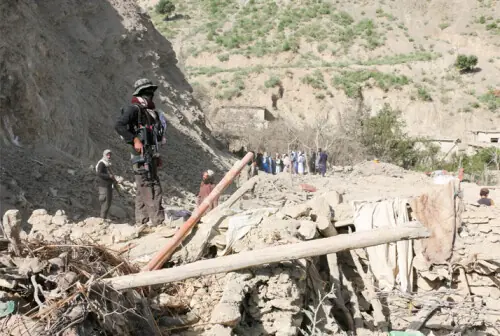
WASHINGTON, Nov 16: While the October 8 earthquake had catastrophic human consequences, its overall economic impact on Pakistan is expected to be small, the World Bank said on Wednesday. The bank’s Global Economic Prospects report for 2006 predicts that Pakistan will manage to achieve a 6.6 per cent growth rate during the current fiscal year.
“This strong growth can be attributed to increased consumption, investment, exports and industrial production in both countries, the report says.
GDP growth in South Asia is estimated at 6.9 per cent in 2005, up from 6.8 in 2004. For 2006, regional gross domestic product is expected to slow to 6.4 per cent.
Growth in other South Asian nations, meanwhile, is expected to decelerate from 5.9 per cent in 2004 to 5.1 per cent this year. This slowdown reflects increased political instability in Bangladesh and Nepal, flooding in Bangladesh, and the after-effects of the tsunami in Maldives and to a lesser extent in Sri Lanka.
In Afghanistan, favourable weather boosted agricultural output and GDP.
The South Asia region will also receive an estimated $32 billion in remittances in 2005, a 67 per cent increase from 2001. With recorded inflows of $21.7 billion in 2004, India received the most in remittances in the world, followed by China and Mexico at $21.3 billion and $18.1 billion, respectively.
Of other South Asian countries, Pakistan received $3.9 billion and Bangladesh $3.4 billion.
Meanwhile, in Sri Lanka, remittance receipts are larger than tea exports, and in Nepal, remittances account for nearly 12 per cent of GDP.
Long-term growth in South Asia is forecasted to average around 5.5 per cent during 2007-2015, reflecting a rising contribution to growth from the private sector. Trade reforms, banking-sector liberalization and re-regulation, privatization, and infrastructure development are all expected to improve the investment climate, productivity growth, and ultimately incomes.
Despite the emphasis on remittances from developed countries, remittances sent from developing countries –- the so-called “South-South flows” –- represent 30-45 per cent of total remittances. In South Asia, most migrants move to another developing country.
On the global level, high oil prices, capacity constraints and gradually rising interest rates are the key factors that have been dampening the global expansion. “Until recently, strong global demand and rising non-oil commodity prices have mitigated the impact of rising oil prices on oil-importing developing countries,” said Andrew Burns, one of the chapter authors of the report.