LNG terminals’ capacity to be increased to meet demand


 9
9


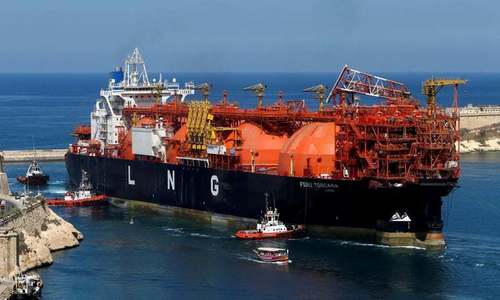
LAHORE: The increasing demand for gas in the country has forced the government to get the re-gasification capacity of the two private liquefied natural gas (LNG) terminals in Karachi increased to 1,500 million cubic feet of gas per day from 1,200mmcfd to ensure uninterrupted supply to domestic consumers on priority.
The situation may worsen in the upcoming winter, especially in Punjab, if agreements with the terminals are not signed for the purpose, Dawn has learnt. “At present, the Sui Southern Gas Company (SSGC) is providing 150mmcfd to K-Electric. The company is utilising another 150mmcfd to meet the demands of other sectors, which is leading to low supply of Re-gasified Liquefied Natural Gas (RLNG) to Punjab from 1,200mmcfd to 900mmcfd,” an official source in the petroleum ministry told Dawn on Saturday.
“If this situation persists and the re-gasification capacity of the existing two LNG terminals is not increased from 1,200mmcfd to 1,500mmcfd on time, the situation will be very disturbing, especially for domestic consumers, in the upcoming winter,” he warned.
The country’s total indigenous gas production is approximately 3,000mmcfd at present that includes over 2,600mmcfd from Sui (Balochistan) and parts of Sindh. Since Khyber Pakhtunkhwa’s local gas production ranges from 300mmcfd to 400mmcfd, the country is importing 1,200mmcfd of LNG to meet the demands of Punjab, which generally remains in trouble owing to gas shortage.
Punjab likely to suffer a colder winter amid gas shortage
When the demand for gas increases manifold across the country in winters, Punjab fares the worst as its total demand jumps to 2,300mmcfd or so. Similarly, Sindh has also been experiencing shortages for the last couple of years due to a decline in indigenous gas exploration and consumption. Moreover, winter also leads to a massive increase in gas consumption in Quetta and other areas of Balochistan from 50mmcfd to more than 150mmcfd.
“Under the constitution, the province with indigenous gas reserves, exploration and production has the first right to use and meet its demand and then supply the rest to other provinces that have no such arrangements. So, the gas producing provinces of Balochistan, Sindh and KP first meet their demand and then provide the rest to Punjab,” the official explained, adding: “That is why Punjab gets a dedicated supply of 1,200mmcfd of RLNG.”
The official said if Punjab did not get the full supply of 1,200mmcfd of RLNG and around 1,300mmcfd of indigenous gas, it would not be able to fully meet the demand of domestic consumers in the upcoming winter.
According to an official source in the SSGC, although the government quarters are in touch with the LNG terminals in Karachi, it is yet to finalise arrangements for enhancement of their re-gasification capacity.
“The SSGC’s winter and summer demand is roughly 1,500mmcfd and 1,200mmcfd, respectively. But it receives up to 1,100mmcfd. In addition, it is also using 150mmcfd of RLNG and providing it to the K-Electric for power generation. So, there will be a shortfall of 300 to 400mmcfd of indigenous gas for the company in winter,” the official, requesting anonymity, told Dawn.
Another issue, he said, was the means to enhance re-gasification capacity of the terminals. “Recently, one of the terminals tried to increase its capacity through a large Floating Storage Re-gasification Unit but that violated certain clauses of the agreement with the government. So they have started replacing the bigger one with the smaller one as per the agreement to avert any complications,” he maintained.
Published in Dawn, August 22nd, 2021