ECP links EVM use with political concurrence

ISLAMABAD: Voicing its reservations over the credibility of the proposed use of electronic voting machine (EVM) in the next polls, the Election Commission of Pakistan (ECP) on Tuesday linked the matter with political concurrence.
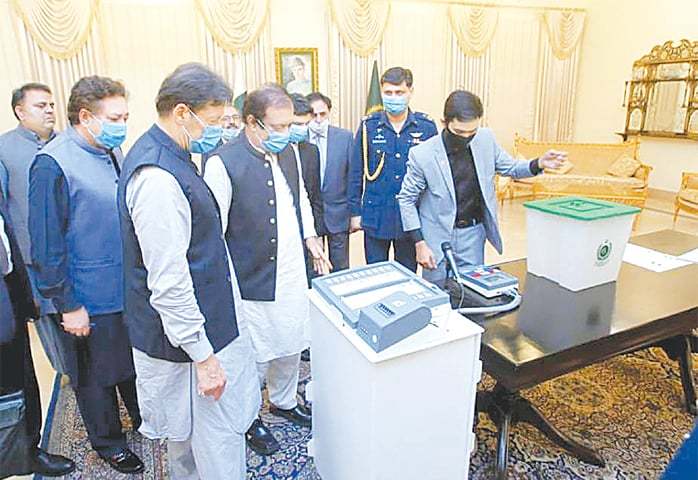
As Science and Technology Minister Syed Shibli Faraz briefed the ECP on the EVM’s functions, some pertinent questions were asked by Chief Election Commissioner (CEC) Sikandar Sultan Raja and the two other members of the commission and officers about the possibility of the EVM being hacked.
The ministry’s team insisted that hacking was not possible because the EVM would not be linked with the internet, but a question was also asked about an in-built system in the machines to technically hijack the polls and achieve desired results.
Shibli Faraz assured the Commission that all its fears and reservations would be addressed, saying that the prototype was open to modifications.
Minister says modifications possible to address any concerns
The ECP formed a technical evaluation committee to thoroughly examine the machine and present its report to it.
The Commission approved hiring of a technical consultant to assist it about the EVM, internet voting for overseas Pakistanis, data centres, preparation of electoral rolls and other related projects.
The CEC said the Commission believed in transparency of the electoral system and in principle wanted the use of technology for it.
He, however, said the technology must not be insecure and besides being in line with the ground realities should also enjoy confidence of all stakeholders, including political parties, civil society and voters.
He said various changes in the law would be required before introduction of the EVM.
Later talking to newsmen, Minister for Science and Technology Shibli Faraz insisted that an understanding had been reached between the ECP and the government to hold the 2023 general elections with “the help of technology”.
He said the government would hold follow-up meetings with the ECP, but the targets decided in those discussions would be in keeping with the timeline of the next elections.
The minister said the government was now taking the EVM toward perfection. “We will also have to enact laws and the ECP will have to look at some internal processes.”
He said that the government would pursue the legislation process before formally rolling out the EVMs for the polls. He said it would be better if the ECP, after its satisfaction, underwent all processes, including tendering of machines beforehand.
Mr Faraz insisted that the ECP was satisfied with the EVM, but the Commission mooted a suggestion as well. “We talked on a supposition if a voter or a presiding officer kept pressing a voting button on the machine, what would happen then?”
He said a system had already been prepared for voter identification and it could be added to the machine to prevent its misuse by the presiding officer. “We have a mechanism ready to keep check on a voter to prevent the presiding officer from playing a voter [in order to manipulate the voting process],” he added.
The minister said the government would also launch awareness programmes to apprise the masses of problems in the previous conventional voting system and how utilisation of technology could be helpful in future.
“We will also approach opposition parties to convince them on the matter,” he said.
The minister, however, said the opposition’s arguments should be based on logic and rationale if they wanted to make the election system non-controversial.
In reply to a question, he said the government was clear in its vision to use technology in the next elections. It would be good to test EVMs in LG polls or by-elections that will be held under the ECP supervision, he added.
Published in Dawn, August 18th, 2021