



 0
0

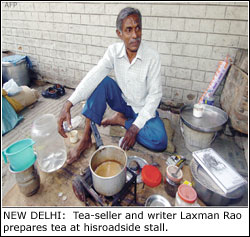 NEW DELHI: Laxman Rao, a prolific writer who has run a roadside tea stall for 30 years, believes he can finally stop making the tea next year and devote himself to writing full time.
“When I get some money from my books and I establish my literature then I can say I’ve become an author,” says the slight, greying 51-year-old. “I’m waiting for that.”
Literature is a cruel mistress, and few know that better than Rao, who has written some 18 novels, plays and political analyses in Hindi but figures nowhere in the canon of famous Indian writers in English, such as Booker Prize winners Salman Rushdie and Arundhati Roy.
A correspondence-course college degree, one literary award, one meeting with a prime minister and dozens of press mentions have not yet helped Rao to realize his dream of being a full-time author either.
But he’s not daunted and there’s no writer’s block after publishing six works on his own, the latest a political analysis called “The Traditionalism of Indian Politics,” which should be bound this week.
But the cost of paper, printing and binding means Rao has never been able to live off his writing.
Instead, he supports his wife and two sons on the Rs4,000 he earns each month from his tea stall.
Originally from the western Indian state of Maharashtra, Rao was bitten by the writing bug by a tragic incident in his small village when he was 16.
At the start of the school year, a student named Ramdas was drowned while swimming in a stream on his way home from a visit to another village.
“He was a very nice boy. Actually he used to be a wastrel but then he changed his ways. And then suddenly he died,” said Rao, who was so moved by the death he wrote a novel named after the boy.
Rao soon decided that he would have to write in India’s main official language Hindi, instead of his native language Marathi, and leave his village.
After moving to Delhi in 1975, Rao frequented a weekly book market where he devoured the Hindi translations of Shakespeare’s plays, as well as Greek tragedies like Oedipus Rex and Antigone.
“Macbeth” is a particular favourite.
“The heroine in that is very daring — you don’t see that in every woman. That I liked,” says Rao, who also speaks English.
But although he has read their reviews, he doesn’t plan to read Rushdie’s “Midnight’s Children” or Roy’s “God of Small Things”, anytime soon.
“From their titles it looks like they were not written for this country. They were written for a particular class,” says Rao.
In the last decade, publishers abroad have rushed to put out books from Indian writers in English, a boom sparked by the popularity of Vikram Seth’s 1993 novel, “A Suitable Boy”.
Rao says writing in Hindi was important to him because he wanted to reach other Indians like himself.
Indian has dozens of official languages, but the Federation of Indian Publishers and Booksellers says that of the 70,000 new titles published in each year, almost a third are in English.
“Maybe if I could write in English I would become a very successful author, but if my country people can’t understand it, what’s the point?” asks Rao.
Still, he admits his years as a Hindi writer have not been lucrative.
“Thirty years of writing in Hindi language has kept me on the street,” he says.
But that may soon change.
Rao, who sleeps only four hours a night and travels around the city on a bicycle to hawk his books to schools and libraries, expects to sell 2,000 copies of his latest tome, which advises India’s three main political parties to work hard and be less corrupt.
“For a Hindi writer that’s very good. Sometimes they just sell 200 to 300 copies,” says Rao.
At 300 rupees a copy, he says that should earn him a profit of 160,000 rupees after he pays the typesetter, printer and binder who are doing his work on credit.
Politicians who buy the book may get a discount.
He plans to save part of the money and use the rest to publish some more of his works and the profits should help him ease out of the tea business.—AFP




























