Pakistan a democracy only in name: Hamid Mir



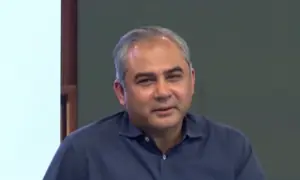
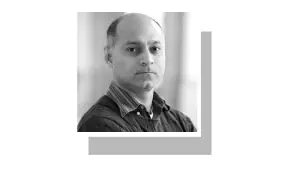
LONDON: The anchor and host of the now-off air primetime show Capital Talk on Geo, Hamid Mir, in a wide-ranging interview to the BBC World Service, criticised the shrinking space for press freedom and the growing “climate of fear” for journalists in Pakistan.
Hamid Mir spoke from Islamabad with Stephen Sackur, the host of the BBC show HardTalk.
“There is democracy in Pakistan but there is no democracy. There is a constitution in Pakistan but there is no constitution. And I am a living example of censorship in Pakistan,” Mir told Sackur, who asked if the Pakistani state is out to silence independent journalism.
Sackur introduced his guest as a high-profile journalist who has faced a string of threats and attacks. In the 90s, Mir was kidnapped and interrogated, and later survived two assassination attempts. Sackur told listeners that since June 2021, Mir’s show and his column for Jang Group have been banned by his employers after he made a speech about intimidation and attacks against journalists.
“He [Mir] says shadowy forces operating beyond public view wield enormous power in Pakistan and are seeking to control the media,” Sackur said.
Anchor speaks about curbs to press freedom, censorship in BBC interview
Sackur pushed Mir to name names, and asked who these forces are who silence journalists, but Mir shied away from taking names. Instead, he said in the past he had named the head of an intelligence agency as allegedly conspiring to attack him, but that individual did not appear before a high-powered commission probing the attack.
When asked by Sackur if intelligence agencies were behind the attack on journalists, including Asad Toor who was attacked in his home in the capital by masked men, Mir said: “These are documented facts and the state agencies and the intelligence agencies were blamed again and again for organising attacks or kidnapping journalists.”
Sackur then drew attention to the six sedition cases lodged against Mir, reminding him that if he is convicted he could serve life in prison. To this, Mir said: “I am ready to face a life in prison because if they will… convict me at least the whole world will come to know what is going on in Pakistan. The whole world is already aware of what is going on because I am living example of censorship in Pakistan. Everybody knows what happened to Hamid Mir and why he is banned and everybody knows the names of the people which I have not mentioned.”
Mir added that journalists want the rule of law to be established in Pakistan. “If a journalist is asking questions, don’t try to silence his voice.”
Sackur asked Mir why, on the one hand he “sounded absolutely sure that he knows who is responsible for attacks on journalists, but on the other hand in his Washington Post article he said he did not name anyone.
Mir said he was not backing off, and that the article referred to a case filed against him in Gujranwala which alleged that he tried to malign senior generals.
“So I clarified, that I never mentioned any name...I thought that maybe my tone was very harsh and maybe some people were trying to give the impression that I was blaming the whole institution, so I clarified my position that I am not blaming the whole institution. I only talked about some individuals who are trying to silence the voice of the media.”
When Sackur asked Mir if he was disappointed by his employers for not standing by him, Mir said: “Yes, certainly I am disappointed but I can understand the circumstances.”
Sackur asked Mir whether he thinks Prime Minister Imran Khan personally wants him taken off air and tried. Mir said: “Imran Khan is not directly responsible for imposing a ban on me. I don’t think he wants me to be off air. But like past prime ministers, he is not a very powerful prime minister…he is helpless and he can’t help me.”
Published in Dawn, August 10th, 2021