IN the aftermath of what came to be known a decade ago as the Arab Spring, Tunisia stood out on two counts. It was where the self-immolation of a desperate street vendor sparked popular protests that toppled a long-standing dictator and resonated across much of the Arab world. It was also where the fragile democracy subsequently cobbled together seemed just about sustainable. Until now.
In the wake of widespread protests on Sunday against the country’s Covid-19 response and restrictions, Tunisia’s president, Kais Saied, sacked the prime minister and suspended parliament. “We have taken these decisions,” he proclaimed, “until social peace returns to Tunisia and until we save the state.”
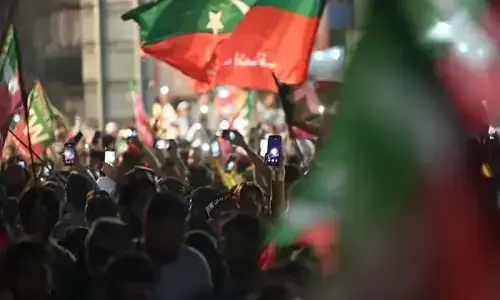
The decision was greeted on the streets of Tunis with jubilation, although by Monday it had morphed into confrontation. Evidently, many Tunisians are pleased to see the back of the government headed by Hichem Machichi, who was backed by the largest party in parliament, Ennahda, described as ‘moderate Islamist’.
Others fear that Tunisia is heading down the same track as Egypt. The latter was among the biggest disappointments of the Arab Spring. The toppling of Hosni Mubarak led, democratically, to a Muslim Brotherhood government, which was overthrown amid protests highlighting its incompetence, leading to a military-backed regime even more repressive than that of Mubarak.
The Arab Spring’s sweetest dream goes sour.
There are significant differences, though, between Abdel Fattah el-Sisi and Saied. The latter is not a military man but an academic specialising in constitutional matters who won the 2019 presidential election as an independent. Yet, he threatened violent protesters with a military response.
The extent to which he enjoys the backing of Tunisia’s army is unknown. But the security forces, not least the police, have remained largely unreformed since the era of Zine El Abidine Ben Ali, Tunisia’s chief honcho from 1987, when he toppled Habib Bourguiba, until he fled to Saudi Arabia, the favourite destination of deposed Muslim autocrats, in 2011.
It was mainly the inadequacies of his regime as an economic manager that put paid to Ben Ali’s ambitions as president for life, while brutal curbs on the freedom of expression meant that the seething popular resentment remain unexpressed. When the anger could no longer be contained, after the death of the beleaguered fruit and vegetable seller Mohamed Bouazizi, it exploded.
The explosion was heard around the world, and resounded particularly loudly in Tunisia’s neighbourhood, where other dictators ruled. Mubarak’s ouster was an exceptionally momentous occasion, following the daily mobilisations on Tahrir Square. But the democracy that emerged was brief and it ended brutally.
The response in Egypt was at least ostensibly indigenous. In Syria, resistance to Bashar al-Assad’s regime sparked a civil war that morphed into an international conflagration that remains unresolved. Libya turned into a Nato battleground, portending long-term chaos. Saudi Arabia and the UAE, having curbed the likelihood of local eruptions, collaborated in thwarting opposition to Bahrain’s monarchy. And then they joined hands to destroy Yemen’s aspirations, which remains an ongoing project.
Tunisia’s political forces collaborated to steer clear of such outcomes. To some extent, liberals and Islamists found common cause. Ennahda thrived, but a parliamentary majority remained beyond its reach. It nonetheless signed up to a new constitution recognised as relatively progressive in the Arab sphere.
Kais Saied has been accused of violating that constitution and mounting a coup. Tunisia’s future will depend on what he has in store and on whether he is backed up by forces that matter.
All too many of the conditions that catalysed the 2011 upheaval remain in place, notably the level of unemployment. All too many young people are still condemned to a precarious existence, without any visible means of support. Tunisia remains keen on further assistance from the IMF, but that would inevitably entail further job losses and removal of subsidies. Transcending the neoliberal paradigm does not appear to be an option for the time being.
Recently, a Tunisian popcorn vendor was fined 60 dinars for not wearing a mask. He told his tormentors that if he had enough money for a mask, he would spend it on his children.
Tunisia’s pathetic pandemic response, which accounts for the highest per capita rate of fatalities in the region, has contributed to the popular resentment against the authorities. What is the likelihood, though, that the concentration of power in the president offers a solution?
It should be obvious before long whether or not Saied’s overreach is well-intentioned — and even if it is, the consequences may be dire. But the overall lesson for the Arab world — and, for that matter, countries everywhere — is: it’s best not to count your springs before they bear fruit.
Published in Dawn, July 28th, 2021