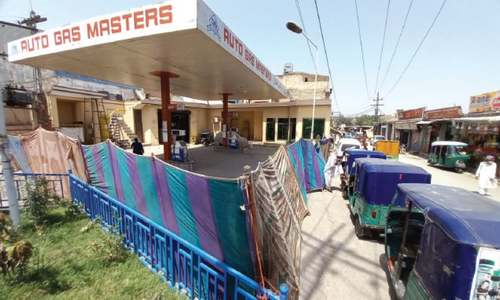
Transport sector complains about govt entities’ hurdles


• Private sector’s role in gas supply chain being impeded
• UGDC’s right to allocation of terminal, pipeline capacity protected by legal framework
ISLAMABAD: The transport sector, which relies on Compressed Natural Gas (CNG), has complained to the prime minister that it is facing unfair treatment and roadblocks from various government institutions and entities in matters of pricing, supplies, imports and pipeline capacity for transportation of liquefied natural gas (LNG).
In a detailed representation, the copies of which have been shared with the Ministry of Energy and the Oil and Gas Regulatory Authority (Ogra) and the Universal Gas Distribution Company (UGDC) has explained the ‘impediments against private sector role in gas supply’ since its inception in 2014.
In a nutshell, the CNG sector is required to pay the highest price for local gas or imported LNG compared with all other consumers and is the first to face shutdown after any supply shortfall and yet it is not allowed to arrange its own imports in violation of rules, regulations and laws for fear that its cheaper imports could upend public sector monopolies.
The UGDC’s chief executive officer, Ghiyas Abdullah Paracha, said as gas shortfall increased to 2BCF (billion cubic feet) against the annual supply of 4BCF, the CNG sector along with several other gas-based industries were seriously affected and faced survival challenges. With the government decision to promote private sector in reducing gas shortfall, several representatives of CNG sector established the UGDC in 2014 as a special purpose vehicle for import and regasification of LNG and supply of regasified LNG to CNG stations and other customers by using the pipeline of gas companies through which they were already getting supplies.
“Ever since its incorporation, UGDC made hectic efforts and took countless actions to secure all commercial arrangements so as to supply re-gasified LNG to CNG stations and other gas customers,” Mr Paracha said.
He put on record that when UGDC turned out as the successful bidder to utilise surplus capacity of LNG terminals, the auctions were not successfully concluded by public sector entities. “UGDC ran from pillar to post for the allocation of pipeline capacity which is the quintessential channel to transport regasified LNG to CNG stations and gas customers” as allowed under third party access (TPA) rules and sought to sign gas transportation agreements with gas companies with the support of the petroleum ministry but in substance none of these requests and MOUs were effectively approved or signed.
The result was that due to the unused contracted terminal capacity of Pakistan LNG Ltd, an accumulative burden of about $100 million (about Rs16bn) was passed on to gas consumers in the last three years, according to official working at the rate of $20 million in fiscal year 2017-18, $35million in 2018-19 and $45million in 2019-20.
In addition, another Rs80bn import saving to the government had been wasted in the shape of non-availability of gas, regasification charges to LNG terminals, transportation charges to gas companies and tax losses.
“Contrary to its productive use the private sector’s role in the gas supply chain appears to be impeded,” the UGDC said, explaining that one or more private sector licensees were allocated around 200MMCFD of terminal capacities to import and regasify LNG, and were further allocated the corresponding pipeline capacities to allow such licensees to transport and supply re-gasified LNG to gas customers.
Mr Paracha said the actions and outcomes suggested that “UGDC is not deliberately allowed to exercise its right of lawful trade and business — to undertake the gas supply business” despite being the country’s first private sector gas shipper and this was in violation of laws, Ogra Gas (Third-Party Access) Rules, 2018.
These rules obligated the Sui companies to offer and facilitate access to available capacity to the licensed shippers and allocate available capacity on first-come-first-serve basis and offer and facilitate access to available capacity to shippers. It warned that UGDC’s right to allocation of terminal and pipeline capacity was well protected by legal framework.
“It will only be fair and reasonable to honour UGDC’s right in practice too,” Mr Paracha said, warning that any allocation of pipeline and terminal capacities to an entity on the existing or future gas infrastructure in deviation from the above legal framework will not only be infringement of UGDC’s rights but also be a statutory violation.
Published in Dawn, July 19th, 2021