Nigerian delegate hospitalised, Ugandan weightlifter missing as Tokyo marks week to Olympics


 0
0

TOKYO: A Nigerian Olympic delegate became the first visitor to the Tokyo Games admitted to hospital with Covid-19, broadcaster TV Asahi said on Friday, as Japan battles to stem rising local infections a week before the showpiece event starts.
The individual, a non-athlete in their 60s, tested positive on Thursday evening at the airport with mild symptoms but was hospitalised because of age and pre-existing conditions, the broadcaster said, without giving details.
Organisers have promised that the Games, starting on July 23 after being postponed from last year because of the pandemic, will be “safe and secure”.
The coronavirus has however infected increasing numbers of athletes and others involved with the Games, and authorities were on Friday trying to track down a Ugandan weightlifter who went missing from his training camp.
Julius Ssekitoleko, 20, was training as part of the nine-member Ugandan team in Izumisano, Osaka prefecture, city officials said.
Teammates realised the athlete was absent around noon Friday when his saliva test sample was not delivered and they found his hotel room empty, city officials said. There was no training on Friday morning and he was last seen in his room in the early hours of Friday.
On Friday, the government said it had asked organisers to investigate reports of Games participants breaking virus rules, a day after Olympic chief Thomas Bach insisted the regulations “are working, and they are enforced”.
Ssekitoleko’s disappearance in Izumisano city comes after two members of Uganda’s delegation tested positive in Japan, including a coach who was isolated at the airport.
“The city is making all efforts to search for the individual. We have reported the matter to police,” a statement from city authorities said.
Uganda’s Olympics Committee said Ssekitoleko had not qualified to participate in the Games and was therefore due to fly home. There was no suggestion that he was infected with Covid-19.
Tokyo is under a state of emergency for the duration of the event, and organisers have imposed strict testing and limits on delegates’ activities to try to soothe the concern of the Japanese public, many of whom wanted the Games cancelled or postponed again.
But most curbs to limit its spread in the host city — where infections hit a six-month high on Tuesday — are voluntary and many people say they have grown weary of them.
Among the latest batch of high-profile competitors to pull out due to Covid-19 was tennis player Alex de Minaur, ranked 15th in the world, who the Australian Olympic Committee said had tested positive prior to his departure for the Games.
Japan has seen a smaller Covid-19 outbreak than many countries, with fewer than 15,000 deaths despite avoiding harsh lockdowns, but only around 20 percent of the population is fully vaccinated so far.
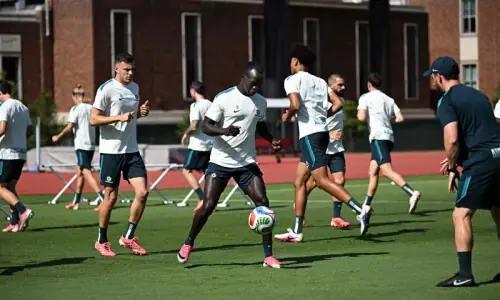
Dozens of teams are already in Japan — some at training camps dotted around the country, and others in the Olympic Village, where national flags have been hung on the buildings housing delegations.
However, Australian basketball star Liz Cambage announced her withdrawal over the mental health risks of staying in “terrifying” bubble conditions. British weightlifter Sarah Davies said living in the bubble felt like “prison”.
MIXED REACTION FOR BACH ON HIROSHIMA VISIT
On Friday Bach got a mixed reception in his visit on Friday to Hiroshima, the city where the first wartime atomic bomb was dropped, to deliver what organisers have called a message of peace on the first day of an “Olympic Truce”, an ancient tradition to cease hostilities during the Games.
The visit sparked some controversy, with more than 70,000 people signing a petition opposing his trip and accusing Bach of using Hiroshima and Nagasaki “to promote the Olympics... even though it is being forced through despite opposition”.
Bach’s vice-president John Coates also appeared Friday in Nagasaki, the second city that was hit by an American atomic bomb in 1945.
Bach and Coates have been meeting daily with Japanese officials from Prime Minister Yoshihide Suga to Tokyo Governor Yuriko Koike, repeating their message that the Olympics will be safe and secure. He was accompanied to Hiroshima by Seiko Hashimoto, the president of the Tokyo Olympic organising committee.
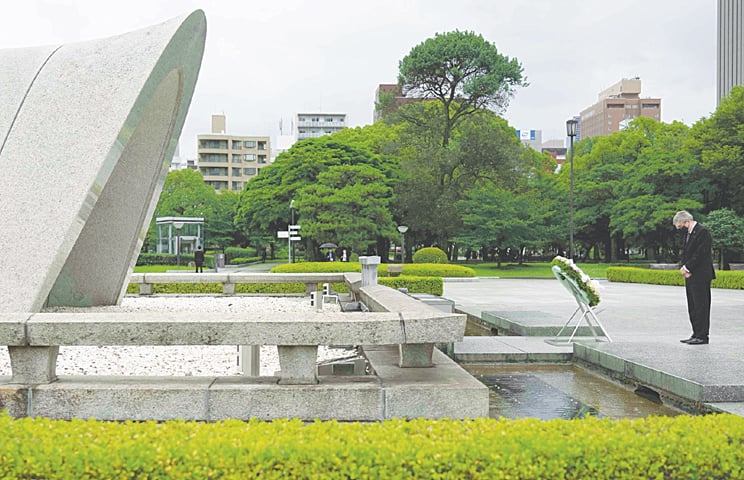
Bach laid a wreath and observed a minute of silence in the rain in front of the Peace Memorial Park cenotaph. Faint voices of protesters, who were kept at a distance, could be heard shouting “go home Bach” and “you’re not welcome here”.
Dozens of protesters were seen near the Atomic Bomb Dome with signs that read ‘Cancel The Olympics’ and ‘No Bach’.
“You should understand you are not welcome here,” one protester said, speaking into a microphone.
Describing himself as “humbled” by the trip, Bach said the Games would “be a beacon of hope for a better and more peaceful future”.
Bach has been meeting local officials in recent days and Japanese media said Friday he had asked the prime minister to consider allowing spectators into Olympic venues if the virus situation improves.
Up to 5,000 spectators are currently allowed at non-Olympic sporting events in Tokyo, despite the emergency.
But officials argue the Games is different because it involves multiple events happening simultaneously, posing a greater risk of crowds gathering and infection spreading.
Published in Dawn, July 17th, 2021