Haiti President Jovenel Moise assassinated at home: interim PM


 7
7


Haiti President Jovenel Moise was assassinated at his home early on Wednesday morning by a group of armed individuals, interim Prime Minister Claude Joseph announced.
Joseph said he was now in charge of the country.
Moise's injured wife was in the hospital, according to Joseph, who urged the public to remain calm, and insisted the police and army would ensure people's safety.
“The president was assassinated at his home by foreigners who spoke English and Spanish,” Joseph said.
Moise had been ruling Haiti, the poorest country in the Americas, by decree, after legislative elections due in 2018 were delayed in the wake of disputes, including on when his own term ends.
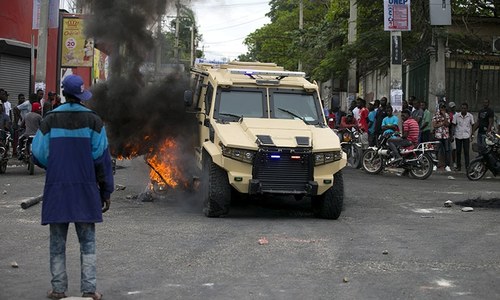
In addition to the political crisis, kidnappings for ransom have surged in recent months, further reflecting the growing influence of armed gangs in the Caribbean nation.
Haiti also faces chronic poverty and recurrent natural disasters.
The president faced steep opposition from swathes of the population that deemed his mandate illegitimate, and he churned through a series of seven prime ministers in four years. Most recently, Joseph was supposed to be replaced this week after only three months in the post.
Multiple crises
In addition to presidential, legislative and local elections, Haiti was due to have a constitutional referendum in September after it was twice postponed due to the coronavirus pandemic.
Supported by Moise, the text of the constitutional reform, aimed at strengthening the executive branch, has been overwhelmingly rejected by the opposition and many civil society organisations.
The constitution currently in force was written in 1987 after the fall of the Duvalier dictatorship and declares that “any popular consultation aimed at modifying the Constitution by referendum is formally prohibited.”
Critics had also claimed it was impossible to organise a poll, given the general insecurity in the country.
Moise had been accused of inaction in the face of multiple crises, and faced steep opposition from swaths of the population.
The United Nations Security Council, the United States and Europe have called for free and transparent legislative and presidential elections to be held by the end of 2021.