Lack of water rules out life on Venus: study


 2
2


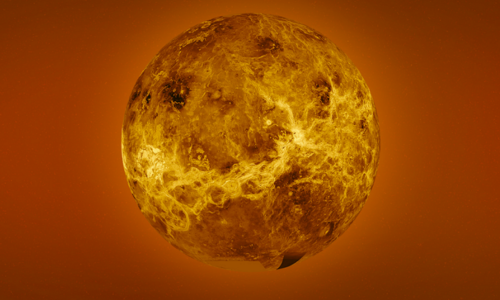
PARIS: A study measuring water concentration in Venus’s atmosphere concluded on Monday that life as we know it is not possible among the sulphuric acid droplets that make up the planet’s famously cloudy skies.
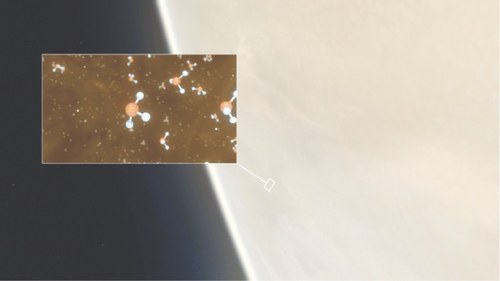
The search for life on our nearest neighbour has so far proved fruitless, although a 2020 paper rekindled hopes for Venus when it claimed to have detected phosphine gas — known to be produced by bacteria on Earth — in the planet’s clouds.
The authors have since called their own findings into question.
But the claim inspired scientists led by Queen’s University Belfast to test the theory from a different angle: whether there is enough water in Venus’s atmosphere to make life possible.
In 2017, microbiologist John Hallsworth discovered a terrestrial fungus that can survive at 58.5 percent relative humidity — the driest conditions at which biological activity has ever been measured.
“We bent over backwards to argue that the most extreme, tolerant microbes on Earth could potentially have activity on Venus,” said Hallsworth at a press conference.
But he said nothing could cope with the miniscule amount of water in the planet’s atmosphere, which is equivalent to a relative humidity of 0.4 percent.
“It’s more than 100 times too low. It’s almost at the bottom of the scale, at an unbridgeable distance from what life requires to be active.”
Jupiter ‘more optimistic’
To calculate the concentration of water, scientists used existing measurements from seven US and Soviet probes and one orbiter mission sent to Venus in the late 1970s and early 1980s.
Chris McKay, a Nasa planetary scientist and co-author of the research published in Nature Astronomy, noted that the conclusions of the study were based on the limited direct observations available, and therefore incomplete.
“It’s hard to imagine that the results will change as we do further exploration,” McKay told reporters.
The team also analysed measurements taken from probes that visited other planets — and discovered potentially the right amount of water activity to support life in the clouds of Jupiter. “The results were much more optimistic,” said McKay.
“There is at least a layer in the clouds of Jupiter where the water requirements are met.” He emphasised, however, that it is much easier to rule out life in Venus’s atmosphere than to prove life is possible in Jupiter’s clouds.
“To show that that layer is habitable we would have to go through all the requirements for life and show that they’re all met,” he said, adding that determining things like ultraviolet exposure and energy sources would require further exploration.
‘Search for life’
Three more Venus missions are planned for sometime around 2030 and McKay feels certain they will confirm the measurements used for the study.
He also said that one mission could shed light on a question not addressed by current research: whether life could have existed on Venus several billion years ago.
“There could’ve been a time when Venus was earth-like,” McKay said.
“One of the missions will fly through the atmosphere and measure trace gases... which will tell us a lot about Venus’s evolutionary history and will start to address questions like how much atmosphere did Venus have, where did it go, what happened?” And the study’s authors hope their method of determining water activity will be applied to planets beyond our solar system — especially with the upcoming launch of the James Webb Space Telescope (JWST) later this year.
“The JWST will be able to determine atmospheric profiles of temperature, pressure and water abundance in exoplanet atmospheres,” the study concludes.
“These will allow assessments of water activity in their atmospheres using our approach.”
Published in Dawn, June 29th, 2021