Cotton crop revival linked to financial viability


 8
8


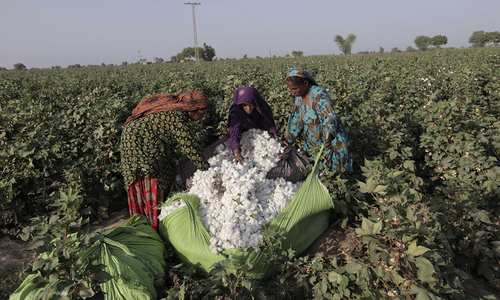
With the country missing out on the cotton sowing target for the 2021-22 season, stakeholders maintain the crop can only be revived if work is done to make it financially lucrative to the farmers.
Cotton was sown on 1.96 million hectares of land against a target of 2.32m hectares fixed for the 2021-22 season. Both Punjab and Sindh missed their plantation targets by 25.7 per cent and 16.7pc, respectively.
During the 2020-21 season, the cotton crop was planted on 2.079m hectares, showing a contraction of 17.4pc over the previous year’s 2.517m hectares.
Since 1986-87, cotton has been planted on an area above or close to 2.428m ha, reaching a high of 3.19m ha in 2004-05. The country harvested 14.26m bales in 2004-05, compared to just 5.57m bales in 2020-21 — a whooping 61pc decline in the last 16 years.
This gradual decrease in cotton output has been forcing the country to rely more and more on lint imports as the textile industry needs 16mn bales per annum to meet its demands. During the 9MFY21, lint imports reached $1.838bn and the figure is likely to cross $2.5bn mark by the year end, further tilting the foreign trade balance against Pakistan.
Cotton crop was blatantly overlooked in Prime Minister’s Agriculture Emergency Programme two years ago. The authorities disapprove any question about the crop’s viability, saying “agriculture does not end with cotton”.
Climate change, harsh weather, pest attacks and poor quality seeds are just some of the reasons that have adversely affected cotton. Add intensifying water crisis, increase in production costs and no minimum support price into the mix and the crop has little appeal for growers.
Talking to Dawn, a senior agriculture officer said that cotton was losing ground in the past in the wake of mealybug and cotton leave curl virus attacks. “However, the trend would reverse next year because of the profit the crop still promises,” the officer said, requesting anonymity.
Central Cotton Research Institute, Multan, Director Dr Zahid Mehmood, who has recently been tasked by the federal government to ascertain the reasons behind shrinking cotton acreage, also stresses this point by saying that cotton cannot be revived until its production is linked with productivity and profitability. “The farmer is ready to plant cotton if, like sugarcane, the crop gives him Rs100,000 per acre income.”
About the challenges facing cotton in the form of alternative crops like maize and rice, he says these alternatives are short lived as prices of these crops dropped this year after a robust demand in the last two seasons.
He goes on to add that the government should announce an indicative price for cotton and make textile millers pay a better price to the growers to attract them back to the crop. “The textile industry is paying more for import of lint than what it offers to local growers,” he added.
Adil Bashir, a textile industry representative, noted that local cotton was costlier than imported one in terms of staple size and contamination.
About fixing a minimum support price, he said that it not the price but rather dropping yield that was an issue. The research institutes should come up with seed varieties capable of a better yield and resilient to the climate change for reducing gate price of cotton, Mr Bashir added.
Published in Dawn, June 29th, 2021