



 0
0

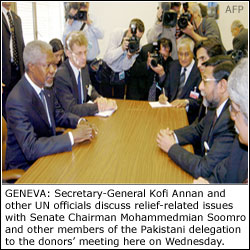 GENEVA, Oct 26: Half a billion dollars of fresh aid was pledged to rebuild earthquake-hit Pakistan on Wednesday after a UN fund-raising drive, but emergency cash to help survivors through winter snows fell far short of UN goals.
The UN recorded $580 million in new aid pledges by donor governments at an emergency conference held in Geneva designed to whip up support for the millions left without food or shelter in the freezing Himalayas after the Oct 8 quake.
But only $15.8 million of that was new cash earmarked for an emergency push to feed and house survivors, leaving the United Nations with only 20 per cent of its ‘flash appeal’ met.
“The good news is that we have very good pledges. The bad news is that we still have too few concrete commitments to the UN flash appeal,” UN emergency relief coordinator Jan Egeland told a news conference.
The funding shortfall raises the spectre that millions of Pakistanis left homeless will face hypothermia or disease as snows block delivery of relief goods.
“Are we going to have tens of thousands of people staying in the rubble and in the snow until it’s too late? Maybe. It’s a logistical nightmare,” Mr Egeland said.
Some UN agencies have already run out of cash, hindering operations. As a result, many of the wounded were forced to submit to emergency amputations due to delayed evacuations, while hundreds of thousands more faced hunger and exposure, he said, adding “we needed the money yesterday.”
Much of the new money was earmarked for reconstruction efforts like homebuilding, such as a $251 million pledge from the Islamic Development Bank. An earlier pledge for $333 million from Saudi Arabia, United Arab Emirates and Kuwait was also largely earmarked for reconstruction.
But Mr Egeland said those pledges, however welcome, failed to meet the immediate needs of those stranded.
“It is, in my view, not right to sit with reconstruction money for one year from now if we’re not sure whether those people will be alive one year from now,” he said.
Earlier, the UN nearly doubled its goal of $550 million in urgent relief aid needed for Pakistan. With the new pledges, the UN has received about $111 million of that.
UN Secretary-General Kofi Annan, who presided over the ministerial conference, said the need for funding was critical as the Himalayan winter approached.
“The scale of this tragedy almost defies our darkest imagination,” he told representatives of about 60 countries. “It is a winter without pity.”
“While no one today could have had the power to prevent the earthquake from happening, we do have the power to stop the next wave: the deaths and despair caused by freezing temperatures and disease, by lack of shelter, food and water.”
Mr Annan urged governments and even individuals to overcome their weariness with a succession of disasters this year and to match the unprecedented outpouring of generosity that followed the Indian Ocean tsunami.
“We need the support of governments, private citizens, the private sector and anyone who can spare a euro, a pound or a dollar,” he told journalists.
The International Federation of Red Cross and Red Crescent Societies, which also took part in the meeting, doubled its separate appeal for 570,000 survivors in the worst-hit areas to $117 million. By contrast, the Red Cross appears to have generated a better response.
Speaking at the conference, Senate Chairman Mohammedmian Soomro called upon the international community and donor organizations to help Pakistan meet its relief, rehabilitation and reconstruction needs.
Mr Soomro led a delegation to the conference organized by the UN office for the coordination of humanitarian affairs in cooperation with the government of Pakistan.
“We hope that by the end of the day, substantial pledges would have been made to provide support and assistance to the affected people of the earthquake in Pakistan,” he said.
He told the conference that the people and government of Pakistan deeply appreciated the support and assistance received from the international community.—Agencies




























