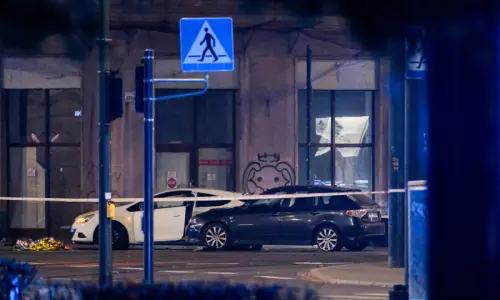
KABUL: At least eight people were killed and nine others wounded on Thursday in two bomb blasts targeting minibuses in Kabul, according to police, in the latest attacks on commuters in the Afghan capital.
Two other buses were hit earlier this week, with fears rising that further unrest lies ahead as Washington withdraws its remaining troops in the coming months.
Police spokesman Ferdaws Faramarz said the first explosion happened on a road in southwestern Kabul near a neighbourhood largely populated by the Hazara community, who have been the frequent target of militant attacks. Four people were killed in that blast, and four others wounded.
Hours later, a second bus was hit just a few kilometres (miles) away, Faramarz said, also in a Hazara neighbourhood. No group has claimed responsibility for the attacks.
Earlier this week, the militant Islamic State group’s Afghan affiliate claimed back-to-back attacks on two buses in Kabul that killed at least 10 people.
Violence has soared in recent weeks as government forces and the Taliban clash in near-daily battles across the rugged countryside, with the militants appearing to focus on battering checkpoints and bases near Kabul.
The surge in violence comes as the US military continues to withdraw its remaining 2,500 troops from Afghanistan. President Joe Biden has ordered the military to complete the pullout by the 20th anniversary of the Sept 11 attacks.
But as the Americans pack up, experts fear Afghanistan will remain home to a number of jihadist groups.
The United Nations Security Council warned in a report published Wednesday that IS continues “to pose a threat to both the country and the wider region”, saying the group had approximately 2,000 fighters inside Afghanistan.“Our schools, worship sites, education centres, wedding halls have been attacked by Daesh in the past and now it’s the buses,” said shopkeeper Ahmad Ehsan, referring to the IS militant group, which claimed responsibility for the Tuesday attacks.
“Nowhere is safe for us. We’re the soft, easy targets everywhere,” he said.On May 8, bombs outside a school in the same part of Kabul killed 80 people, most of them schoolgirls.
University student Sarah Nawandesh, who lives in the western part of Kabul where the bombings took place, said she now took the bus to university in “great fear”.
Police issued a statement on Wednesday urging residents to be vigilant while using public transport.
A senior security official said the bombing of public transport was a worrying new threat in the city of seven million people. “Our enemies change tactics ... this is a new threat, a new trend,” said the official, who declined to be identified.
Published in Dawn, June 4th, 2021