Ordinance about officer’s term sparks legal debate



• Challenge to NAB ordinance pending before BHC
• Ex-prosecutor general finds govt notification erroneous
ISLAMABAD: The presidential ordinance for extending the term of top law officer of the anti-graft body has generated a debate in legal circles, as the matter was sub judice and the National Accountability Bureau (NAB) prosecutor general had already been reappointed for another term of three years in February.
According to federal minister for law and justice Dr Farogh Naseem, the reappointment of Syed Asghar Haider as NAB prosecutor general was made on Feb 15 this year for a period of three years in pursuance of the presidential ordinance which was due to lapse in June, but it was necessary to present this law before the parliament to give it a permanent legal cover.
The appointment of Mr Haider was protected under Article 264 of the Constitution, he claimed, adding that the government wanted to give the ordinance, which was a temporary legislation, a permanent effect through the parliament.
However, a petition is pending before the Balochistan High Court (BHC) that has raised certain legal objections on the presidential ordinance.
The petitioner contended that the ordinance was promulgated by President Arif Alvi at a time when the National Assembly was in session. He argued that since there was no urgency, the promulgation of ordinance was contradictory to Article 89 of the Constitution.
Besides the matter pertained to federal government domain but the federal cabinet had not been consulted on this, which was against various judgements of the Supreme Court, the petitioner further argued.
The court admitted the petition for hearing with the observation that “the contention so raised, requires consideration” and issued notices to the attorney general for Pakistan, advocate general for the province and NAB’s prosecutor general.
Earlier in 2010, the then NAB prosecutor general Irfan Qadir had to tender resignation when the Supreme Court of Pakistan had declared his re-appointment as void.
The apex court order had said that Mr Qadir had remained NAB’s prosecutor general for three years and, thus, he could not get any extension though Mr Qadir argued he had served in the bureau from 2003 to 2006 and his second appointment was a fresh one.
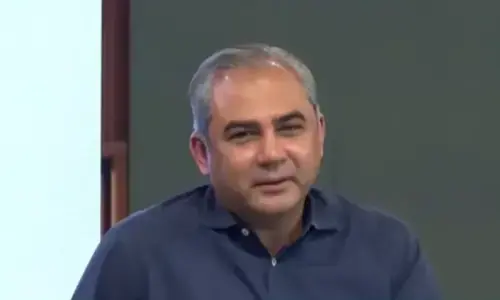
Talking to Dawn, Mr Qadir said the law ministry had erroneously issued the notification of reappointment of Mr Haider. According to him, it is the case of fresh appointment as the law never bars appointment of a prosecutor general after he completes the term.
In contrast, Judge Mohammad Bashir of a district and sessions court had been reappointed at least four times as the accountability judge of Islamabad since 2012.
Section 5 (a) of the National Accountability Ordinance says: “A judge of court who is a serving district and sessions judge shall hold office for a period of three years from the date of his initial appointment as such judge.”
Sources said the re-appointment of NAB’s prosecutor general could be used as a pretext for giving extension to NAB chairman retired Justice Javed Iqbal who will complete his term in October.
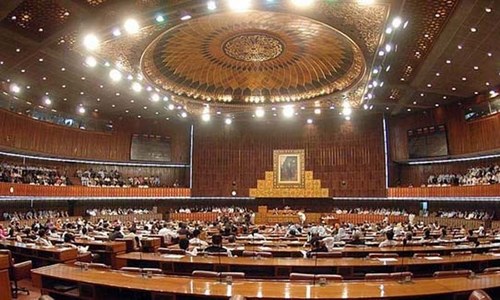
The ministry of parliamentary affairs last week presented a resolution for extending the NAB ordinance, which was adopted by the National Assembly amid strong resistance from the opposition. The NA Speaker allowed the passage of the resolution though the opposition had drawn his attention to an incomplete quorum, leading to protest.
According to members of legal fraternity, the National Accountability Ordinance clearly bars an extension in the tenure of prosecutor general. Section 8(a)(iii) of the ordinance said:
“The Prosecutor General Accountability shall hold office for a [non-extendable] period of three years.”
However, through the ordinance, President Alvi amended the said provision as “the Prosecutor General Accountability shall hold office for a period of three years and shall be eligible for reappointment for a similar term or terms.”
Former special prosecutor of NAB Imran Shafiq said the move reflected that NAB was being controlled by the government. He said that the appointment of prosecutor general was already defined in NAB ordinance, but the government attempted to take away those powers through a temporary legislation.
Also, this was not an appropriate time for such reappointment when NAB was about to conclude series of investigations against politicians belonging to the incumbent regime and filing of references was imminent, as with such a ‘favour’ the prosecutor general would remain indebted.
Published in Dawn, June 1st, 2021