



 0
0

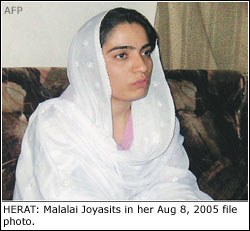 KABUL: In two minutes, two years ago, Malalai Joya secured her name in Afghanistan’s modern history. Only 25 years old and little known outside her home district in the far west of the country, she caused an uproar when she stood up to powerful warlords responsible for years of brutal civil war and told them what no one else dared: that they deserved punishment.
Commanders at the meeting, called to discuss a post-Taliban constitution, were furious.
Some delegates rushed at her, yelling “Allahu Akbar” (God is the greatest) and demanding her expulsion. Soldiers leapt to protect her; women shouted in her defence that she was young and should be forgiven.
Death threats followed and Joya had to stop travelling for fear of her life.
But she is still determined to continue her battle against the men she says are responsible for ruining her country and will take the fight to the first parliament in more than 30 years when it sits later this year.
“My goal is the total disarmament of warlords, to bring to justice war criminals,” she told AFP last week from Farah province after it was confirmed she had won a seat.
She said she planned to rally other like-minded parliamentarians into a front against the fighters. She also wanted to push “reconstruction and fighting for the rights of women.”
With the results from last month’s elections being finalised in stages, indications are warlords implicated in war crimes and crimes against humanity in the early 1990s will make up a significant share of the new parliament — up to about half, according to some estimates.
They will likely include Abdul Rasul Sayyaf, who led a faction implicated in abductions, summary executions and the shelling of civilian areas in Kabul, and Haji Mohammad Mohaqiq, implicated in similar incidents.
Analysts say one of the first things the commanders, whom Joya called felons and criminals in her outburst, could do is use their clout to vote to award themselves amnesty.
“They should be taken to national and international court,” Joya proclaimed at the 2003 meeting, her boldness rare in a country emerging from the harsh Taliban rule, under which women were barred from public life.
Joya’s young life reflects Afghanistan’s tumultuous modern history. She was only four when her family fled the country in 1982, joining hundreds of thousands of Afghans who had escaped the Soviet invasion three years before.
She lived in refugee camps in Iran and later in Pakistan, where she finished her schooling. At 19 she began giving literacy classes to women.
In the meantime the Soviets left Afghanistan. The remaining communist regime collapsed into years of cruel civil war that ended when the Taliban took control of most of the country in 1996.
Unable to keep away from her homeland even at the height of the Taliban’s tyranny, Joya returned in 1999 and set up a secret school for women in the western city of Herat.
For two years she gave lessons at great personal risk, with the Taliban outlawing education or work for women and forcing them under the all-enveloping burqa. “That was the best I could serve women at the time,” Joya said.—AFP




























