0
0

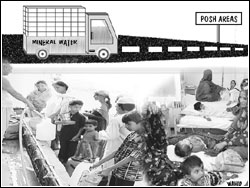 KARACHI: While the business of private mineral water bottlers is thriving in cities, Managing Director Karachi Water and Sewerage Board (KW&SB) Brig Iftikhar Haider rules out the possibility of sell-off of the KW&SB in near future.
Listing many reasons against KW&SB’s privatization, he said that the board’s situation is different from that of electricity and telecommunications. “Without power and telecom people can live, but without water there can be no survival,” he said.
When asked about any future sell-off plan for KW&SB, Brig Iftikhar said that it is not a viable entity for privatization at the moment as it needs complete restructuring to improve its revenue generation, supply system and functioning.
Opposing complete privatization of Water Board, he floated the idea of public-private partnership by contracting several independent components of water distribution system like treatment plant, sewerage, maintenance etc., to the private parties but keeping monitoring and overall control with public sector.
Elaborating, he said the private sector could manage the water affairs efficiently but it would only do this on promise of good returns on their investment, this would mean higher prices for consumers.
“If the government inducts highly professional and skilled engineers and spend on laying new lines and replacing the old ones, the system would definitely be improved. However, the government is not in a position to do so”, he observed.
He said that the KW&SB has one of the largest networks of lines of about 5,500-km and its maintenance cost is Rs2 billion, but due to financial constraints we spend only Rs200 t0 Rs300 million, which is peanut in view of its huge size. “How can you expect any improvement in the system? It is deteriorating because we have been able to even maintain the existing infrastructure with only 300 engineers”, he lamented.
“It is a miracle that the system is running,” the Brigadier said, who started looking after the KW&SB affairs from May last year, “It has reached its optimum level of efficiency as its hard-working staff who are not equipped with required machinery/equipment and without direction is doing what they can”.
He said he had given a comprehensive presentation to the Sindh Governor in September for the Board’s complete restructuring. The Governor in principal had agreed on proposals regarding an area-based division of water distribution system.
“Division of this system in five or six zones can improve the efficiency and bring good results in the shape of better provision of water and as it would also generate competition, which will ensure improvement in service provided,” the Brigadier hoped.
He said that unfortunately the most important aspect of good governance had always been the secondary for those who were at the helm of the affairs and the result was that the system was not functioning properly as some of the pipelines laid down 50-years back and some even before partition have developed cracks.
He admitted that the poor quality of piped water to some extent had promoted the use of bottled/mineral water which was beyond the affordability of majority of people, but the KW&SB had planned to install 100 community water filter plants in this megapolis and clean drinking water would be distributed free of cost.
The mega city of over 15 million populations requires 650-700 million gallons per day water but the KW&SB could manage hardly 540 mgd and of this about 342 mgd is treated.
Water as social and cultural good is indispensable for leading a life with human dignity and its provision — besides other utilizes like gas, power etc. — has always been the responsibility of the government, but in some countries the task has been assigned to the private sector, hence the cost to afford it is rising after the commercialization.
The water management is still the job of the government and the quality of drinking water is not satisfactory as majority of people especially in rural areas have no access to clean drinking water and the bottled/mineral water is a luxury for them, which they cannot afford. The urban areas have the networks of piped water, which generally speaking cannot be termed fit for drinking.
While there is no plan for the commercialization of water sector, the mushroom growth of private bottled/mineral water companies both in formal and informal sector has taken the market by storm with different price tags.
In many areas, where the water flow maintains at a normal speed through out the day, people have started marketing clean water in big plastic cans since water quality, provided by KWSB, lacks uniformity in many areas. These people, in connivance with KW&SB officials, are now doing a booming business. It is not clear whether they run their business by paying a meager water tax every year after consuming huge quantity or they have made special arrangements with the KW&SB officials by paying a regular tax and consuming more.
Because of rising demand, mineral water operators have been jacking up prices for the last few years. There seems to be no check on mineral water bottlers. Moreover, majority of these bottles and water cans do not carry any price tags.
Shahid Siddiqui, Head of Corporate Affair of Nestle Pure Life, told Dawn that bottled/mineral water the world over is considered safer for consumption. “In Pakistan the trend of consuming mineral water has gained popularity among the people who can afford it as they doubt the quality of piped water.”
Dr Mohammad Ashraf, chief of research at Pakistan Council for Research in Water Resources (PCRWR), talking to this reporter from Islamabad informed that about 48 brands of bottled and mineral waters were in business across the county. Of these 15 brands were tested by the council and declared unfit for consumption, while few were carrying deficiency of chemical elements and over dozen were fit for consumption.
When asked was there any check on such unfit brands, he said recently the council had been empowered to take action against sellers of such brands, but the SRO issued in this respect failed to mention the guidelines and parameters of its area of jurisdiction.
Answering a question he said that about 67 per cent of total population had access to piped water, but it included both drinking and irrigation water.
He said that the total water availability stood at 188 million acres foot (MAF) out of which 138 maf come from rivers, lakes etc., and 50maf ground water, but he regretted that about 40 per cent go wasted as the management of water resources was not being done properly.
He was critical of privatization of water sector: “when a government cannot manage it efficiently how would the private sector run it with meagre resources?”