Pakistan holds India responsible for delay in Mumbai case


ISLAMABAD: Pakistan on Sunday observed that India’s reluctance to send witnesses had stalled progress in the Mumbai attack case.
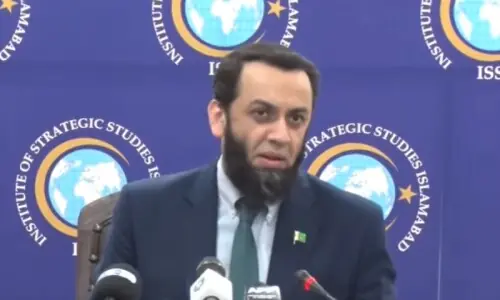
A Foreign Office spokesman in a statement issued here on Sunday said that Pakistan was fully abiding by its own statutes and fulfilling international obligations in the case, and India was responsible for the delay.
“The investigations, prosecutions and subsequent convictions, through due process, are a reflection of effectiveness of Pakistan’s legal system, which operates independent of any extraneous factors or influences,” the FO spokesperson said.
The statement came following a US State Department’s response to the recent conviction of Zakiur Rehman Lakhvi saying they were encouraged on the development; however his crime was far beyond financing terrorism.
In a statement, the State Department urged Pakistan to further hold him accountable for his involvement in terrorist attacks, including the Mumbai attacks.
“The State Department is encouraged to reserve its concern for the active aiding, abetting, planning, promoting, financing & execution of terrorist activities by India for which sufficient irrefutable evidence has already been provided,” the spokesperson said.
He said that the legal process in the Mumbai case had remained stalled due to reluctance by Indian side to send witnesses for cross-examination by the Pakistani court.
Meanwhile, Pakistan has voiced its concern over India getting chairmanship of three key panels of the United Nations Security Council (UNSC) including the Taliban sanctions and counterterrorism committees.
Foreign Office spokesman Zahid Hafeez Chaudhry while reacting to the development said it was important that members of the Security Council ensured that India was not allowed to abuse its position as a non-permanent member of the UNSC.
About Indian assumption of the UNSC as non-permanent member, he said it was ironic that India was able to sit on a UN body whose resolutions on Jammu and Kashmir had been persistently and defiantly flouted by it for the last 70 years.
“India’s negative role in maintenance of international peace and security - the prime mandate of the UNSC - is well known,” the spokesperson remarked.
He said India’s state-sponsorship of terrorism in Pakistan and its elaborate schemes and global network for spreading disinformation about Pakistan had also been fully exposed with irrefutable evidence.
He regretted that India continued to oppress Kashmiris and deny their inalienable right to self-determination that was guaranteed to them under numerous resolutions of the UN Security Council.
“India’s bellicose rhetoric and belligerent actions pose a threat to peace and security in the region and beyond”.
He said that ceasefire violations by India across the Line of Control and the Working Boundary, targeting innocent civilians and populated areas, had become a matter of routine.
The spokesman regretted that India continued to impede access of Security Council-mandated UN Military Observer Group for India and Pakistan (UNMOGIP) to hide these violations.
“The international community is well aware of India’s standing today as a state sponsor and perpetrator of terrorism, and as a massive violator of human rights,” he said.
“We are confident that other responsible members of the Security Council will remain mindful of these facts and not allow India to abuse its position as a non-permanent member of UNSC,” he observed.
The spokesperson said that India would not be able to evade responsibility and accountability for its widespread violations of international law in IIOJK and beyond by virtue of its membership of the UN Security Council.
India has been asked to chair three important committees of the United Nations Security Council (UNSC), Ambassador of India to UN TS Tirumurti said on Friday.
“Happy to announce that Flag of India #India will be chairing 3 key subsidiary bodies of @UN #SecurityCouncil during #IndianUNSC (2021-22): Taliban sanctions committee, #CounterTerrorism committee (for 2022), #Libya sanctions committee,” TS Tirumurti tweeted.
Tirumurti said the Taliban Sanctions Committee has always been a high priority for India. Chairing this Committee at this juncture will help keep the focus on the presence of terrorists and their sponsors, threatening the peace process in Afghanistan, he added. It is also called the 1988 Sanctions Committee.
The Libya Sanctions Committee is a very important subsidiary body of the council, which implements the sanctions regime, including a two-way arms embargo on Libya, an assets freeze, a travel ban, measures on illicit export of petroleum. “We will be assuming the Chair of this Committee at a critical juncture when there is an international focus on Libya and on their peace process,” Tirumurti said in a video message.
On January 4, India began its eighth term as a non-permanent member of the UNSC.
Published in Dawn, January 11th, 2021