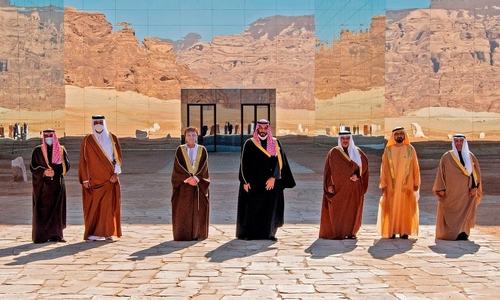
MEETING in the northern Saudi town of Al-Ula on Tuesday, in the shadow of the ancient metropolis of Madain Saleh, the princes and potentates of the six-member Gulf Cooperation Council called for ‘solidarity and stability’. The highlight of the event was the warm embrace between Saudi Crown Prince and de facto ruler Mohammed bin Salman and Qatari Emir Tamim bin Hamad.
Up till recently, such displays of camaraderie were unthinkable, as Riyadh led a campaign — backed by the UAE and Bahrain — to isolate Doha, holding up a charge sheet of lengthy ‘transgressions’ committed by Qatar. Saudi Arabia has reopened land, sea and air borders with Qatar after links were snapped in mid-2017. While fellow GCC members Kuwait and Oman are believed to have played a role in the rapprochement, the thaw has largely been engineered by the US; Donald Trump’s son-in-law and Middle East emissary Jared Kushner was in Al-Ula, keeping a watchful eye over the proceedings.
While the detente is a positive development, questions remain over the intentions. If the motive is to improve regional relations by adhering to the principle of Gulf solidarity, then the move should be welcomed. However, if the alliance is being nudged to form a united front to confront Iran, then there would be reason to worry. Speaking at the ceremony, the Saudi crown prince reinforced the need for unity to confront the “Iranian regime’s ... plans for sabotage and destruction”. It should be noted that one of Riyadh’s major complaints against Doha was that the latter was moving closer to Iran and Turkey, both states major rivals of the Arab bloc for regional influence.
Moreover, the establishment of relations between the UAE and Bahrain with Israel has also complicated matters, considering Tehran’s long-standing opposition to Tel Aviv. Iranian leaders have said that any attack on their country will be answered with strikes on US interests in the region. Most of the Gulf monarchies host American military bases of various descriptions.
Elsewhere in the Gulf, Iran has started to enrich uranium to 20pc, while it has also seized a South Korean vessel in the Strait of Hormuz for ‘causing pollution’. Apparently the Iranians are not happy with Seoul freezing billions of dollars of Tehran’s funds in its banks. Considering all of the above variables, the situation in the Gulf is highly delicate. Any attempt by the Trump administration, or its local client Israel, to confront Iran militarily is likely to have catastrophic results. While the US is clearly the superior military power, Iran has mastered asymmetrical warfare tactics in the region. Therefore, instead of beating the drums of war, the Arabs and Iran must adopt the path of dialogue to create a modus vivendi in the Mideast. Hoping for American intervention, or giving Israel a conduit in the Gulf, will bring nothing good to this volatile region.
Published in Dawn, January 6th, 2021