ISLAMABAD: Majority of the foreign funded power projects are moving at a snail’s pace, resulting in non-disbursement of committed international funds despite payment of commitment charges.
A meeting of the National Coordination Committee on Foreign-Funded Projects (NCCFFP) on Thursday noted with concern that eight out of 14 key projects in power sector had become “problematic” or ‘partially-satisfactory’.
The total funds committed by foreign lending agencies and bilateral creditors for these projects stood at $3.42 billion but more than $3.030bn could not be disbursed due to slow progress by authorities concerned.
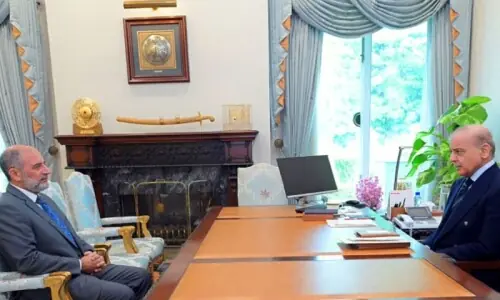
The meeting was presided over by Economic Affairs Minister Makhdoom Khusro Bakhtyar and attended by Energy Minister Omar Ayub Khan.
$3bn left undisbursed due to ‘slow progress’
An official told Dawn that some of the projects had become “white elephants”. Disbursements for these projects stood at about 0.2 per cent and the country is paying commitment charges at 2pc, he said. This happened despite the fact that Pakistan direly needed foreign inflows to support balance of payment.
“Total disbursement against committed portfolio is slightly above 10pc as only $373m could be utilised out of $3.4bn. This is affecting our reputation among the donor community,” said a senior government official who attended the meeting that reviewed progress of the development projects of power sector funded by Asian Development Bank, World Bank, Islamic Development Bank, Japan, France, Germany and USA.
“This shows that the sector is not only a major source of financial bleeding on federal budget and burden on consumers with rising circular debt and electricity rates but foreign assistance committed by lending agencies is not being utilised to address those challenges” the official added.
Progress on six projects (out of 14) involving $883m foreign funding was noted as ‘satisfactory’ even though total disbursements for them stood at $126m and about $742m were still outstanding.
Two projects having $86m foreign funding were described as ‘partially satisfactory’. Disbursements for these projects stood at $42m and $44m were outstanding. Six projects involving about $2.45bn were described as “problematic” with total disbursement of $205m and an undisbursed chunk of $2.244bn.
About 63pc share ($2.144bn) portfolio pertained to the National Transmission and Despatch Company (NTDC) and was found to be the centre of problem. Most of its projects were behind schedule by 18-20 months. A couple of projects in generation and distribution sector have also been delayed by 40-60 months. This is mainly because of delay in land acquisition, bidding problems and hiring of relevant staff even though there were many examples of over-staffing. The meeting set a deadline of December 31 to address land acquisition for right of way and other related problems but noted with concern that issues identified two months ago remained unmoved so far.
Informed sources said the energy minister gave his personal commitment to speed up the process and not leave issues unresolved at the disposal of the relevant entities.
Secretary and heads of line departments of Power Division. Deputy Chairman, Planning Commission, Secretary EAD, Representatives of PM’s Office, Finance Division and Provincial P&D Departments and Boards of Revenues also attended the meeting.
An official statement said Bakhtyar had called the high-level meeting to track physical and financial progress and identify issues and bottlenecks hampering smooth implementation of foreign-funded projects in power sector. He pointed out that the government was focusing on energy sector reforms and energy efficiency through development of renewable and clean energy at affordable prices, reliable transmission system and improved distribution network.
Ayub directed various departments of power Division to fast track implementation of the projects and prompt redressal of issues for expeditious execution of projects in energy sector. “He especially emphasised on the major problematic projects including Jamshoro Power Generation Project, Advance Metering Infrastructure and CASA 1000 & Other Transmission Lines and set the timelines to resolve the bottlenecks,” the statement said.
Both ministers agreed to hold follow-up meeting of National Coordination Committee on Energy sector next month.
Prime Minister Imran Khan had constituted the high-level NCCFFP in order to fast track the disbursement and implementation of external economic assistance as the lending agencies wanted sector-wise meetings with prime minister due to consistent delays.
PM Khan had assigned the Ministry of Economic Affairs to convene the meetings of this committee and submit a progress report to him on monthly basis.
Published in Dawn, November 6th, 2020