0
0

NEW DELHI, Sept 28: India and Pakistan are agreed on the need to withdraw troops from the Siachen Glacier but are stuck on verifying each other’s positions before they pull back, the Indian defence minister said on Wednesday.
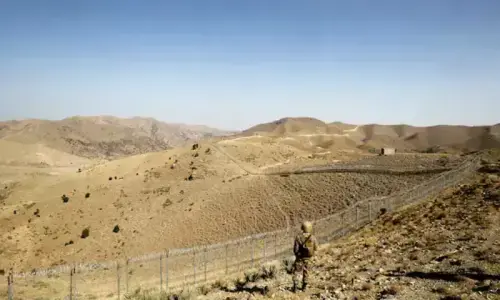
Several thousand soldiers of the two countries have died on the world’s highest battlefield, 18,000 to 22,000 ft high in the mountains of northern Kashmir.
The nuclear-armed rivals have held several rounds of talks to end the stand-off but have never been able to agree on finalising a deal.
“We have agreed, they have agreed to withdraw troops from the present positions,” Defence Minister Pranab Mukherjee told Reuters in an interview.
“The disagreement is, where we are demanding that we must identify the places ... where we were before withdrawal so that there is a record that the respective country’s troops occupied these places,” he said.
“Pakistan’s point of view is when we have agreed to withdraw ... what is the relevance (of this) after the withdrawal agreement is signed,” Mr Mukherjee said in his first interview to a foreign news agency.
India was insisting on marking positions as it wanted to record evidence in case the glacier was reoccupied, he said.
Siachen is an icy wasteland close to where the frontiers of India, Pakistan and China meet in the disputed Himalayan region of Kashmir, at the heart of nearly 60 years of enmity.
The South Asian rivals are involved in a slow peace process to resolve a range of differences, including the central dispute over Kashmir. But some analysts question the glacier’s strategic value to either nation.
ICY WASTELAND: Prime Minister Manmohan Singh and President Pervez Musharraf held talks on the sidelines of the United Nations General Assembly in New York this month but failed to announce any breakthrough.
However, Gen Musharraf said the two sides had made considerable progress on Siachen, without elaborating.
The two countries’ foreign ministers are due to hold talks next week to review the peace process.
There has been no fighting on Siachen since November 2003, when a ceasefire came into effect. But both sides have lost more troops there in the past two decades to altitude sickness, sub-zero temperatures and avalanches than to enemy action.
Mr Mukherjee said India had “positive information” that Pakistan retained bases to send guerillas into Indian held Kashmir.
“The number of infiltrators have come down but the infiltration attempts have not been reduced substantially because we have frustrated a large number of attempted infiltrations,” the minister said.
“We have repeatedly been telling Pakistan that this is one area which you should address.”—Reuters