Occupied Kashmir shuts down in protest against land laws

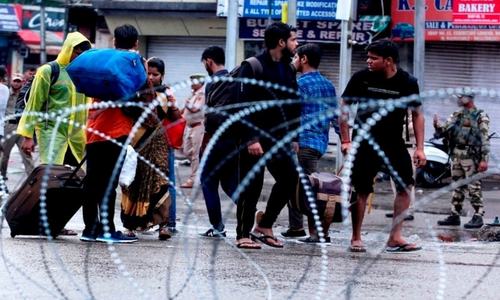
SRINAGAR: Shops and businesses were shut in several parts of Occupied Kashmir on Saturday as separatists challenging Indian rule called for a general strike to denounce new laws that allow any Indian to buy land in the disputed region.
Indian forces in riot gear patrolled streets in held Kashmir’s main city of Srinagar in anticipation of anti-India protests. Public transport also stayed off the roads.
Held Kashmir’s main separatist grouping called the strike in protest against new land laws that India enacted on Monday, allowing any of its nationals to buy or its military to directly acquire land in the region. Pro-India politicians in Kashmir have also criticised the laws and accused India of putting the disputed region’s land up for sale.
The new legislation ended or modified most laws that governed local land rights. It also abolished land reform laws of the 1950s that redistributed large patches of land to landless farmers.
The move has exacerbated concerns of Kashmiris and rights groups who see such measures as a settler-colonial project to change the Muslim-majority region’s demography. They are likening the new arrangement to the West Bank, with settlers living in guarded compounds among disenfranchised locals. They say the changes will reduce the disputed region to a colony.
Until last year, Indians were not allowed to buy property in the region. But in August 2019, Prime Minister Narendra Modi’s government scrapped Kashmir’s special status, annulled its separate constitution, split the region into two federal territories Ladakh and Jammu-Kashmir and removed inherited protections on land and jobs. The move triggered widespread anger and economic ruin amid a harsh security clampdown and communications blackout.
The new laws, part of a series of hard-line Hindu nationalist policies by Modi, also authorise the Indian army to declare any area as strategic for operational, residential and training purposes against Kashmiri fighters.
The Indian government said the decision was made to encourage development and peace.
“I want to say this forcefully and with full responsibility that agricultural land has been kept reserved for farmers,” Lt Guv Manoj Sinha, New Delhi’s top administrator in Occupied Kashmir, said recently. “No outsider will come on those lands.”
The government has also said it only wants to invite outside industries into the designated industrial areas.
The pro-freedom conglomerate said in a statement that India was undermining any possibility of peaceful resolution of the Kashmir dispute.
“Instead, a policy of permanent demographic change is aggressively being pushed to snatch our land, destroy our identity and turn us into a minority in our own land,” the statement said, adding that “laws are being invented and amended by New Delhi and forcibly thrust upon the people”.
Published in Dawn, November 1st, 2020