Explainer: Can Trump call in troops to quell Election Day unrest?


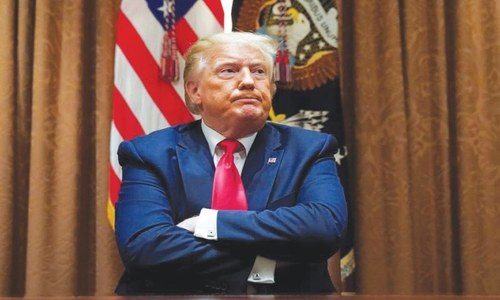
US President Donald Trump has declined to commit to a peaceful transfer of power if he decides the November 3 presidential election results are fraudulent and has proposed mobilising troops under the 200-year-old Insurrection Act to put down unrest if he won.
“Look, its called insurrection. We just send them in and we do it very easy,” Trump told Fox News in September.
What is the Insurrection Act?
Under the US Constitution, governors of US states have primary authority to maintain order within state borders. The 1878 Posse Comitatus Act bars the federal military from participating in domestic law enforcement.
Analyse: Will the US election produce an orderly transfer of power or lead to legal battles and strife?
The Insurrection Act, an exception to the Posse Comitatus Act dating back to 1807, permits the president to send in US forces to suppress a domestic insurrection.
The Insurrection Act has been invoked dozens of times in US history, but rarely since the civil rights movement of the 1960s.
It was last invoked in 1992 by President George H.W. Bush when the acquittal of four Los Angeles police officers in the beating of Black motorist Rodney King led to deadly riots. California's governor supported Bush's use of the law.
The act gives a president “awesome powers” and should be used as a last resort, said retired Army Maj Gen John Altenburg, now a Washington lawyer.
Did Trump invoke the act in response to this year's anti-racism protests?
Trump considered invoking the act in response to violence and looting at mostly peaceful anti-racism protests in June. Trump dropped the idea after public pushback from Defence Secretary Mark Esper. Instead, Trump sent US Department of Homeland Security agents to cities like Washington, DC, and Portland, Oregon.
These agents had military-style equipment, but they were civilians and not members of the armed forces.
In the event of unrest on Nov 3 or in the ensuing days, Trump is more likely to activate these federal agents than the military, said Jimmy Gurul, a University of Notre Dame law professor and former Justice Department official.
To do so, Trump would need to cite some violation of federal law that the agents are policing against. The DHS agents sent to Portland earlier this year were tasked with enforcing a law against vandalising federal property like courthouses.
Can Trump activate the National Guard?
Yes, the US government could activate, or “federalise”, the Army National Guard, a reserve force of part-time soldiers. These civilian soldiers are usually activated by governors, but federal law also allows the US government to mobilise them.
Once federalised, National Guard soldiers are under the full command and control of the defence secretary until they are returned to state status.
This year, many state governors have activated the National Guard to respond to the coronavirus pandemic and support local enforcement in quelling disturbances.
So Trump need not have a governor's approval for sending in troops?
Right. Under the Insurrection Act, if a president determines that a rebellion has made it “impracticable” to enforce US law through ordinary judicial proceedings, he may activate the armed forces without a governor's approval “to enforce those laws or to suppress the rebellion”. Historically, presidents and governors have generally agreed on the need for troops.
Trump can activate DHS agents, who are federal government employees, or the National Guard, without state approval.
However, there are limits on the president's power. Federal law makes it illegal for the military or other federal agents to interfere with an election. Deploying the military or DHS to polling places is illegal, for example.
Can a court block a president's use of force?
Yes, but courts have historically been reluctant to second-guess a president's military declarations, said Robert Chesney, a law professor at the University of Texas.
“When a president claims that the facts on the ground warrant invocation of the Insurrection Act, courts ordinarily would not second-guess this,” Chesney said.
Judges, however, could break with precedent if they believed Trump had relied on false claims to justify the use of force, he said.
If Trump sends in DHS or other federal agents, they must respect the constitutional rights of civilians. Advocacy groups like the American Civil Liberties Union accused the agents in Portland of making arrests that violated the constitutional rights of protesters and journalists.
But the Trump administration had the lawful authority to use the agents, legal experts said.