Increasing taxation not possible in declining economy: Hafeez


 6
6


ISLAMABAD: Pakistan on Wednesday asked the international development partners to provide financial support and technical advice to member countries in meeting pro-poor expenditures, job-creating development activities and fighting inequalities caused by Covid-19.
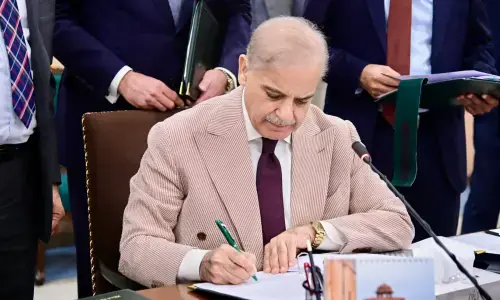
This was stated by Adviser to the Prime Minister on Finance Dr Abdul Hafeez Shaikh while speaking to the ministers and governors of Middle East, North Africa, Afghanistan and Pakistan (MENAP) Region of the International Monetary Fund (IMF) through a video link as part of virtual annual meetings of the IMF and the World Bank, said a press release of the Ministry of Finance.
Dr Shaikh told the participants that increase in taxation was not possible in current difficult times of declining economy. He said the pandemic had undone a considerable share of the achievements of the government. Though there were fiscal constraints after the pandemic, the government devised a strategy to provide whatever it could to its people and businesses by direct cash transfers and sharing the load of various expenditures of the small businesses.
He said the government was determined to provide employment and fight inequality. However, he said, if the government wanted to continue economic reforms, there were two real challenges. These included arranging funding for pro-poor expenditures and prioritising the need for development spending.
Seeks development partners support to meet pro-poor expenditure amid Covid-19 pandemic
The adviser observed that incurring more expenditure to provide for the people at or below the poverty line would require more borrowing as it “would not be possible to increase taxes at a time of declining growth in the economy”.
He said there was a need to adopt a coherent strategy with the partner countries in the region for development and no matter how fair or transparent the governments were in their intentions and operations this unusual situation had made them realise that there is a need for taking support from their friends and development partners in the form of technical advice and financial support and for that all must contribute.
The discussion focused on the impact of coronavirus on the economies of the region, lessons learnt through the experiences and policy guidelines to be adopted to deal with the crisis of such magnitude which has caught the world by surprise.
The participants thanked managing director of IMF Kristalina Georgieva and her team for arranging the discussion and highlighted the need to play a more effective role as a multilateral development partner whose advice would be of much value and importance according to the needs of the changing times.
The participants agreed that the virus had exposed the world’s need for health spending and to focus more on technological solutions to various problems. It was observed that after the first wave of the pandemic almost all the countries had lost a significant share of their GDP and unemployment had become the biggest challenge.
The participants agreed that if the second wave comes, losses will be massive and the achievement made by some countries during the crisis will be lost if the preventive measures were not adopted as a part of their everyday life.
The participants praised the Debt Suspension Initiative of the G-20 and said that there is also a need to provide more finances to the vulnerable economies. It was a consensus that employment generation, equality and inclusion will be the new challenges from the perspective of women and youth and new strategies will be needed to help the women and youth in the region.
Published in Dawn, October 22nd, 2020