



 0
0

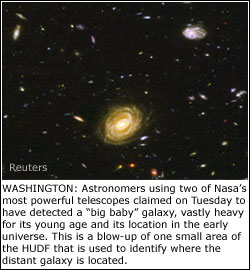 WASHINGTON, Sept 27: Astronomers using two of Nasa’s most powerful telescopes said on Tuesday they have detected a “big baby” galaxy, vastly heavy for its young age and its location in the early universe.
The discovery was surprising, since astronomers have long theorized that galaxies form when stars gradually cluster together, with small galaxies preceding bigger galaxies.
But the stars in this cosmic infant — less than 1 billion years old — have eight times the mass of those in the 13-billion-year-old Milky Way, which contains Earth.
The young galaxy was found by researchers using NASA’s Hubble and Spitzer space telescopes who looked back in time to a point some 800 million years after the Big Bang explosion that many scientists believe gave birth to the universe.
The discovery of this massive, well-developed galaxy at such an early point in time means astronomers may have to adjust their ideas on when galaxies and other cosmic objects can form, said Massimo Stiavelli of the Space Telescope Science Institute, which deals with Hubble’s findings.
“It means that the process of galaxy formation started really very early on,” Stiavelli said in a telephone interview. “It pushes back things like first light, which is the thing we are all hunting for.”
Before the emergence of the first light source, the universe is thought to have been suffused with a generic glow, caused by microwave background radiation from the Big Bang.
The galaxy, known as HUDF-JD2, was hiding in a tiny patch of sky — about one-tenth the size of the full moon — known as the Hubble Ultra Deep Field, because the Hubble Space Telescope made a detailed survey of this area.
Rather than a two-dimensional picture, the Hubble survey is a bit like a core sample of the cosmos, peering narrowly into the vast distance of space, and therefore back in time about 13 billion years.
Even Hubble’s keen cameras could not see this galaxy in visible light; it was only detected in infrared images made by Hubble and an infrared camera at the European Southern Observatory in Chile. In general, older astronomical objects appear redder than younger objects.
The Spitzer telescope, which is sensitive to the light from older, redder stars, found the baby galaxy to be unexpectedly bright in infrared light, suggesting a very massive object, especially for its early era.—Reuters



























