Facial recognition and bathtime bookings: How China's universities are reopening

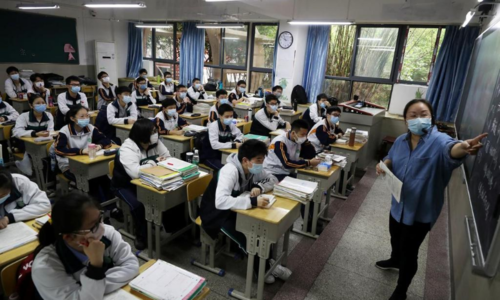
As Covid-19 cases in China sink to new lows, the world’s largest population of university students is heading back to campus in a migration defined by lockdowns, patriotic education and cutting-edge surveillance equipment.
The highly choreographed return comes as Chinese universities revert to in-person instruction for the fall semester after months of pandemic controls.
Some universities have strict rules governing how students eat, bathe and travel. Students in Beijing, Nanjing and Shanghai told Reuters that they must submit detailed movement reports and stay on campus.
“But they haven’t yet told us the specific application process or what reasons will be considered reasonable,” said one student at Beijing’s Renmin University.
Renmin University did not respond to a request for comment. A notice on its social media account confirmed students must apply to leave campus.
At the same time, government procurement documents show dozens of universities have purchased “epidemic control” surveillance systems based on facial recognition, contact tracing and temperature checks.
There are more than 20 million university students in China, and most live on campus in shared dorm rooms, presenting a challenge for health authorities.
On Chinese social media, students have chafed at the controls, which mirror restrictions on the wider population during the height of the outbreak in March.
Responding to the criticism last week during a media briefing, officials from China’s Ministry of Education said that the measures weren’t compulsory for universities, but that students should not leave campuses unless necessary.
They also said “patriotic health campaigns” would be key to successfully reopening universities, and said lessons in “anti-epidemic spirit”, including the “touching deeds” of medical workers, were compulsory.
Hi-tech surveillance
Procurement documents posted online in the past two months by dozens of Chinese universities give insight into campus life in the Covid era, detailing technology systems designed to bar outsiders and collect students’ data.
Many systems call for dozens of cameras that can collect facial data and temperatures, as well as notification systems that require students to enter information multiple times a day.
“All of a sudden we found dozens of cameras in our dorm building, six on each floor,” said a student at Peking University, who asked to remain anonymous.
“It’s like someone is watching you from when you wake up to when you go to sleep,” said another Peking University student surnamed Mei, who found cameras in her dorm when she returned this month.
Peking University did not respond to a Reuters request for comment.
One system at the University of Science and Technology Liaoning cost 429,000 yuan ($62,376) and uses cutting-edge facial-recognition temperature cameras that can spot people without masks, bidding documents show.
The platform compiles a daily “body temperature report”, and stores students’ historical temperatures for 30 days.
Nanchang University in Jiangxi province spent 158,000 yuan on a system that tracks and saves data on students’ movements using their national ID numbers and facial recognition.
A system at Tianjin Normal University collects details on students’ families, the addresses of places they visit off campus and how they get to the university.
It can also send reminders to students and teachers, and those who don’t respond can be flagged to university personnel. Students who spoke to Reuters confirmed a variety of daily reporting requirements.
Shower bookings
The new rules have also given rise to more mundane challenges, students said.
Students returning to Nanjing University said they struggled to book time in the dormitory showers between disinfection rounds.
“Many students can’t wash,” said one Nanjing student surnamed Liu, adding that some sneak in without booking.
Several students said the rules could be flouted. Liu said temperature checks at campus gates were lax, with gate guards waving their thermometers from a distance.
Others said they feared the new surveillance tech would outlast the pandemic.
“I think there is that concern among students, but there’s no option but to accept it,” said Mei, the student at Peking University.