Belarus strongman orders army to defend borders ahead of protests


 0
0


MINSK: Belarusian strongman Alexander Lukashenko on Saturday ordered his defence minister to take “stringent measures” to defend the country’s territorial integrity after mass protests erupted against his claim to election victory.
The 65-year-old authoritarian leader, who said he won a sixth presidential term with 80 per cent of the vote in the August 9 ballot, made the comments while inspecting military units in Grodno, near Belarus’s border with Poland, according to the president’s press service.
Also on Saturday, the president’s main opponent Svetlana Tsikhanouskaya said the people of Belarus would not allow the strongman to treat them as before and he would have to leave sooner or later.
In an interview, she said she was receiving a lot of calls from international leaders, and that all she was asking them for was to support the Belarusian public and respect the country’s sovereignty.
Tsikhanouskaya said she felt safe in neighbouring Lithuania and that she had bodyguards around her, but declined to comment further on her security.
Lukashenko, meanwhile, denounced the recent mass protests, which he said were receiving support from Western countries, and ordered the army to defend western Belarus, which he described as “a pearl”.
“It involves taking the most stringent measures to protect the territorial integrity of our country,” he said.
His visit comes ahead of large-scale military exercises planned in the Grodno region between August 28 and 31.
The former collective farm director claimed that Nato troops in Poland and Lithuania were “seriously stirring” near their borders with Belarus and ordered his troops into full combat readiness.
Lithuanian President Gitanas Nauseda denied the accusation on Saturday.
“The regime is trying to divert attention from Belarus’s internal problems at any cost with totally baseless statements about imaginary external threats,” Nauseda said.
Lithuania’s foreign ministry announced on Saturday that US Deputy Secretary of State Stephen Biegun would visit Lithuania and Russia next week for talks on the elections’ fallout.
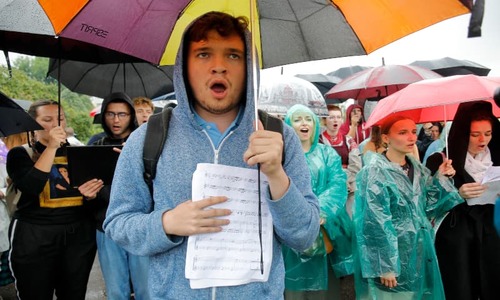
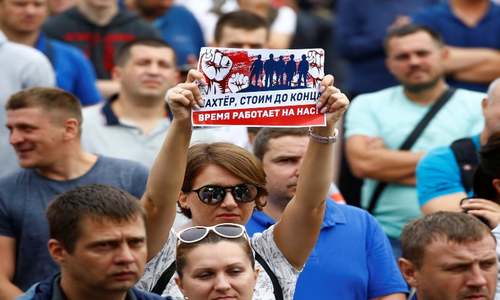
In the Lithuanian capital, he will meet Belarus opposition leader Tsikhanouskaya on Monday as part of efforts to defuse the crisis over the elections, her team said. Opponents of Europe’s longest serving leader have organised strikes and the largest demonstrations in the ex-Soviet country’s recent history to protest his re-election and demand that he stand down.
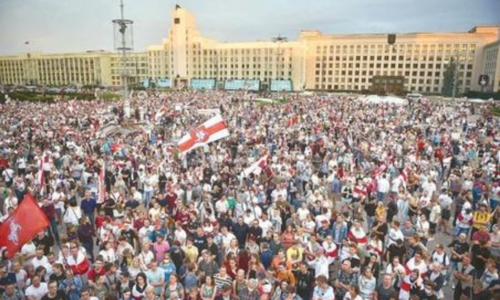
The opposition has called for a major rally in Minsk on Sunday after more than 100,000 people flooded onto the streets of the capital and other cities in Belarus last weekend demanding Lukashenko’s resignation.
The European Union this week rejected his re-election and vowed to levy sanctions against what it said was a substantial number of people responsible for rigging the vote and cracking down on protests.
The Belarusian authorities have opened a criminal investigation into the opposition’s Coordination Council, whose members are seeking new elections and a peaceful transition of power.
Lukashenko has rejected the idea of holding another ballot, dismissed calls to resign and accused the opposition of attempting to seize power.
On Friday he vowed to “solve the problem” of the protest movement.
Published in Dawn, August 23rd, 2020