

Erdogan warns of ‘heavy price’ if Turkish ship attacked
ANKARA: Turkish President Recep Tayyip Erdogan on Thursday warned of a “heavy price” if a Turkish vessel searching for oil and gas in disputed Mediterranean waters was attacked and hinted that one incident had already occurred.
Existing tensions between Turkey and Greece escalated when Ankara this week sent a ship named Oruc Reis to explore off the Greek island of Kastellorizo on Monday.
Several navy ships accompanied the vessel. Greece responded by sending its own ships to the area to monitor Turkey’s activities.
Erdogan appeared to suggest in a speech to members of his ruling party that the Oruc Reis had come under attack during its expedition and that Turkey had responded accordingly.
Greece denies attack on the Turkish ship
“We told them, don’t you dare attack our Oruc Reis. You will pay a heavy price if you attack our Oruc Reis, we said. And they got their first answer today,” Erdogan said.
He provided no detail and immediately moved on to another topic in his wide-ranging address.
In Athens, the Greek defence ministry denied attacking the Turkish ship.
“No incident happened,” a Greek defence official said.
Earlier on Thursday, Erdogan held talks with German Chancellor Angela Merkel and the European Council chief, Charles Michel, in a bid to defuse the tensions.
Erdogan told Merkel “he prefers disputes in the eastern Mediterranean are resolved within the framework of international law and on the basis of fairness and dialogue,” the Turkish presidency said in a statement.
The presidency also said Erdogan insisted to the EU chief that Turkey favoured a solution “which will protect the rights of all countries and benefit everyone” and “reiterated his commitment to defend Turkey’s rights against attempts to disregard them.” A scramble for the energy riches followed the discovery of hydrocarbon reserves in the eastern Mediterranean, with Greece and Turkey bitterly divided over the issue.
The EU has watched the rising tensions with concern, urging Turkey to stop its exploration activities.
France-Turkey ties have worsened especially after a naval incident in June when Paris accused Turkish ships of being “extremely aggressive” towards a French navy vessel.
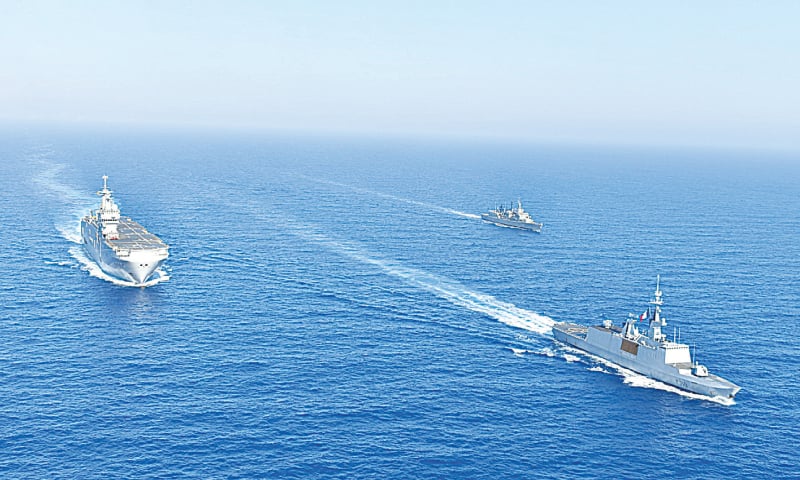
The French government earlier on Thursday further stoked tensions after Paris said it would “temporarily” reinforce its military presence in the eastern Mediterranean.
Published in Dawn, August 14th, 2020




























