ISLAMABAD: An accountability court of Islamabad on Thursday acquitted former prime minister Raja Pervaiz Ashraf, former finance minister Shaukat Tareen, some former bureaucrats and directors of a power holding company in the Sahiwal Rental Power Project case.
The National Accountability Bureau (NAB) had in 2014 filed the reference against Mr Ashraf, Mr Tareen, former federal secretaries Ismail Qureshi and Shahid Rafi, former managing director of the Pakistan Electric Power Company (Pepco) Tahir Basharat Cheema and directors of Pepco Razi Abbas, Wazir Ali Bhaio, Saleem Arif, Abdul Qadeer Khan and Iqbal Ali Shah.
The name of Pepco’s former managing director Munawar Baseer Ahmed had been deleted from the list of accused persons following his demise last year.
The accused persons were charged with allegedly misusing Rs6.1 million, the amount which was paid in term of legal fees.
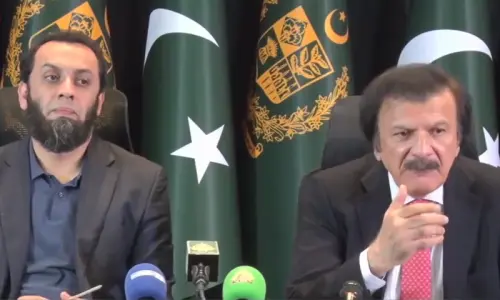
Former finance minister Shaukat Tareen was among accused in reference filed by NAB
Amjad Iqbal Qureshi, counsel for Mr Ashraf and others, during the course of hearing told the court that the said amount was paid to eminent lawyers as legal fee to determine the power tariff and proceedings before the Supreme Court.
Judge Bashir discarded the prosecution case and acquitted the accused persons.
The same court is also scheduled to announce a decision on Pirangheb Rental Power Project. However, the decision has been deferred till June 29.
Ex-PM Ashraf was accused of misusing authority during his tenure as minister for water and power to obtain approval from the Economic Coordination Committee and the federal cabinet for an increase in the down payment to rental power companies from 7 to 14 per cent, amounting to about Rs22 billion.
Mr Ashraf served as prime minister for nine months in the Pakistan Peoples Party government from June 22, 2012 to March 16, 2013. He was made prime minister after ouster of his predecessor, Yousuf Raza Gilani, on the orders of the Supreme Court.
In 2009, the then opposition Pakistan Muslim League-Nawaz brought the RPPs case before the Supreme Court.
The apex court had declared the RPPs as illegal and void ab initio because of alleged wrongdoing in the award of RPPs contracts, including huge mobilisation advance and expensive upfront tariffs. It was not immediately clear how the government planned to pursue corruption cases filed by NAB against former PM Ashraf and former finance minister Tareen in the RPPs case.
The PPP government introduced the RPPs to overcome power shortfall of 2,500MW.
Published in Dawn, June 26th, 2020