0
0

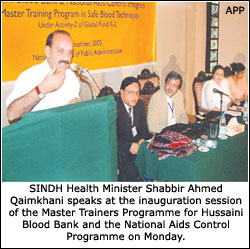 KARACHI, Sept 5: The Sindh government will launch an operation against unsafe blood dealers, both in urban and rural areas, in a week’s time, said the provincial minister for health on Monday. Speaking at the inaugural session of a six-day training programme on safe blood techniques at the NIPA auditorium, Shabbir Ahmad Qaimkhani said that the amendments in the Sindh Safe Blood Transfusion Act made by the Sindh governor recently, had enabled the officials of the provincial health department and other concerned departments to take stern actions, including sealing of unregistered blood banks, to ensure safe blood transfusion system in the province.
According to official sources, about 200 blood banks operating in the province, including over 100 in Karachi, have so far failed to get registered or observe safe blood transfusion requirements, despite notices issued by the Sindh Blood Transfusion Authority. At present only 26 blood banks are registered with the authority.
The amendment to the Sindh Safe Blood Transfusion Act has been aimed at implementing it effectively. The changes provide that any premises being used illegally for transfusion of blood or its products or any blood bank which is not working in accordance with the provisions of the act may be sealed, while on the other hand punishments of imprisonment has been enhanced from two to three years.
Mr Qaimkhani said rules would be framed in line with the new amendments ordered by the governor so that the culprits, who were involved in dirty businesses in the name of blood service, could be brought to book and punished.
He mentioned that some substandard blood transfusion establishments were raided recently, but the persons involved could not be fixed up as the legal provisions were not very effective. He lauded the role of organizers of the workshop and media persons in promoting safe blood practices.
The minister said that very soon a task force would be set up to improve working of blood transfusion services, while special campaigns would also be run and efforts would be made for inclusion of topics on safe blood in educational syllabus to raise the level of awareness regarding safe blood transfusion in the rural and urban areas.
The workshop, “Master training programme in safe blood techniques” is being jointly organized by the National Aids Control Programme and Husaini Blood Bank, with the support of The Global Fund to fight AIDS, Tuberculosis and Malaria.
As many as 26 pathologists, haematologists, medical trainers, transfusion experts and lab technicians selected from all the four provinces and the Azad Jammu Kashmir are likely to get comprehensive training on techniques ensuring safe blood transfusion through proper screening and testing facilities.
Speaking on behalf of the organizers, Dr Sarfaraz H. Jafri said that at least five doctors or senior technicians had been selected for the Master trainers’ programme from each province and AJK, who would finally be imparting the norms and practices of safe transfusion of blood to other concerned in their respective areas.
Referring to the public and private sectors’ collaboration for the training programme, he said that such projects ensured a result after all.
Government agencies, alone cannot deliver the needful due to certain deficiencies in the system, certainly get strength from NGOs, he added.
Dr Asma Bukhari, the programme manager of National Aids Control Programme, said that any move for safe blood transfusion to the masses could not be successful without private sector’s involvement, as they run major part of blood banks and laboratories.
She said that the government wanted to raise the rate of blood scanning in the private sector from 20 to 80 per cent.
Dr S. A. Mujeeb of the Jinnah Postgraduate Medical Centre (JPMC) hoped that the momentum given to the efforts of practitioners and media in the shape of different governmental measures would surely result in the end of unsafe blood practices from the Sindh province.
Dr Farhana Memon, secretary of SBTA, and Altaf Nazim of Husaini Blood Bank also spoke on the occasion.