0
0

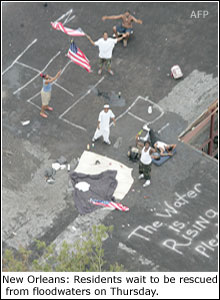 NEW ORLEANS, Sept 1: Authorities suspended an evacuation of New Orleans on Thursday after a shooting at a military helicopter and US President George Bush urged ‘zero tolerance’ for lawlessness in the wake of Hurricane Katrina.
In Washington a senator said that according to his information, thousands of people had died in the calamity.
Shell-shocked officials tried to regain control of the historic jazz city reduced to ruin by Monday’s storm.
The helicopter incident was just part of the chaos that prompted New Orleans Mayor Ray Nagin to order police to drop rescue operations to fight looting and other crime that gripped the city. A National Guard soldier was shot and wounded on Wednesday in the Superdome arena housing thousands of refugees in increasingly squalid conditions.
An angry Louisiana Governor Kathleen Blanco told reporters: “We will do what it takes to bring law and order to our area.
“I’m just furious. It’s intolerable,” she said.
A National Guard official said 60,000 people had gathered at the Superdome for evacuation.
Mr Bush warned against price-gouging of gasoline in the storm’s aftermath and condemned rampant looting.
“I think there ought to be zero tolerance of people breaking the law during an emergency such as this, whether it be looting, or price-gouging at the gasoline pump or taking advantage of charitable giving, or insurance fraud,” Mr Bush said in an interview on ABC’s ‘Good Morning America’.
As more National Guard and Army troops headed into the region to help with relief efforts, thousands of people waited hours or waded through floodwaters to catch rides out of New Orleans, one of the world’s most famous tourist destinations and the birthplace of jazz.
Storm survivors in the Superdome scrambled to get out of the city, clambering onto 300 buses that shipped them 560kms west to another stadium, the Astrodome in Houston.
The first refugees began arriving early on Thursday at the Houston stadium, where Red Cross workers set out thousands of cots and ‘comfort kits’.
HELICOPTER SHOOTING: But the operation was put on hold when shots were fired at Chinook military helicopters being used to transport the evacuees.
“We were told they are shooting at Chinook helicopters and the operation has been put on hold until daylight,” said Gloria Roemer, spokeswoman for Harris County Judge Robert Eckels, who has been involved in the evacuation.
Trash fires near the Superdome and other logistical problems were also delaying the evacuation, Louisiana National Guard’s Lt Col Pete Schneider told CNN.
Elsewhere in New Orleans, gunshots repeatedly rang out and fires flared as looters broke into stores, houses, hospitals and office buildings — some in search of food, others looking for anything of value.
Similar scenes played out in Mississippi where looters freely ransacked stores in Biloxi and Gulfport, both shattered by the storm that slammed into the US Gulf Coast on Monday with 225kph winds and a nine-metre storm surge.
Mississippi Governor Haley Barbour told NBC’s ‘Today’ show that part of the looting problem has been an inability to get enforcement personnel into critical areas. “We will have several thousand National Guard by the weekend and will put a stop to it,” he said.
Hundreds of people are believed to have died in what President Bush said will be one of the worst natural disasters in US history.
Mr Nagin, the New Orleans mayor, estimated it would be three to four months before residents could return. A million people fled the New Orleans area before Katrina arrived.
FLOODWATERS DROPPING: The Army Corps of Engineers said floodwaters had started to drop in New Orleans, which is mostly below sea level and was inundated by water from Lake Pontchartrain after levees broke.
The corps said it would open holes in parts of the city’s levee system to let water drain out while at the same time attempting to fix several large breaches torn out by Katrina’s storm surge. Officials estimated it could take a month to get the water out.
“Many people didn’t have the financial means to get out,” said Alan LeBreton, 41, an apartment superintendent who lived on Biloxi, Mississippi’s seaside road, now in ruins. “That’s a crime and people are angry about it.”
—Reuters