Building safety



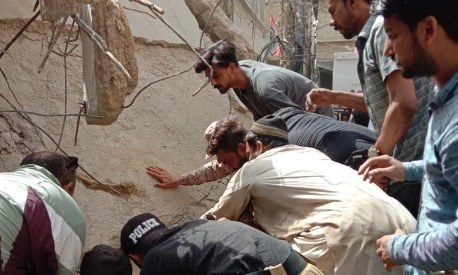
DESPITE the deaths of over two dozen people in the recent Gulbahar building collapse in Karachi, the official response has not reflected the gravity of the issue.
The Sindh government has “reiterated” its resolve to take stern action against illegal construction while the Sindh Building Control Authority yet again let itself off the hook by declaring that the structure had been constructed illegally.
Unsafe construction practices and similar building patterns are common in many parts of Karachi and Pakistan’s other large cities. Single-storeyed structures are converted into multiple-level buildings as the need and greed of real-estate owners multiply. Besides being poorly engineered, these buildings also house dangerous businesses and establishments, such as LPG depots and storehouses of flammable merchandise or chemicals. This goes on right under the noses of the authorities.
The rapid expansion of Karachi’s built space alongside an exponential rise in the population has turned land into a precious commodity. People tend to converge at central locations for residential and commercial purposes, making land in these areas more sought-after, but causing an overall decline in the quality of spaces and structures.
Instead of simply razing weak or old structures to the ground and evicting people from unregulated settlements — rendering thousands homeless — a holistic approach is needed to resolve the issue of densification and overcrowding. What Karachi urgently requires is an ‘urban renewal intervention’ to readjust to its current commercial, industrial, recreational and geographical functions. With the rapid transit projects about to be completed, space would become even scarcer in the city’s core.
Karachi requires an urgent intervention.
In the process of ‘urban renewal’, spaces and structures are readjusted according to their current and future needs, while also fulfilling aesthetic requirements. However, in Karachi, where the list of developmental priorities is endless, this readjustment has to be politically and economically justified, while also being socially acceptable. This would require a long-term vision of redesigning spaces with attention to mobility patterns and their cost-effective use. The authorities can use the expertise of economists, urban planners, architects and engineers to maximise social benefits vis-à-vis monetary returns for the public. If homeowners and small-scale industrialists are shown tangible benefits, they are more likely to comply with the scheme.
The first step could be to check the imbalance in real estate values in the wake of growing commercialisation. In many cases, residents of an affluent locality are compelled to move out if they find a hazardous enterprise being built next door. Similarly, when surrounded by dense residential or commercial development, livestock farms on the city’s outskirts become a nuisance. There are also many cement factories and brick kilns situated within the city limits. These enterprises have to be replaced and periodically adapted.
Squatters living alongside railway tracks, riverbeds and waterways have already been earmarked for relocation by the government. However, many of them have returned to their prior residences after not being compensated or not finding the alternate arrangement suitable. Moreover, the readjustment plans for inner city areas such as Lea Market junction, Empress Market and Lines Area must accommodate the people and traders evicted under the recent anti-encroachment drives. Also, recreational green spaces such as the Khori Garden need to be preserved for community activities in otherwise dense neighbourhoods.
Unless the renewal plan is clear, invites participation from the public and applies equally to all, little improvement can be expected. The Sindh government and municipalities can jointly lead the formulation of policies, but divide the responsibility of implementation procedures at different stages of execution. They can test the waters through a couple of pilot projects in specific areas first, before venturing into a large-scale redesigning of any neighbourhood or commercial area.
Other aspects of the urban renewal plan might include strengthening technical expertise at the municipal level for undertaking various tasks such as uplifting the facade of old buildings, amending structural designs for decaying structures and resolving traffic congestion. Municipalities can also initiate dialogue with the various sections of the public, homeowners, tenants, transporters, representatives of adjoining residential areas and small-scale businessmen, etc.
The authorities will also need the help of civil society organisations to help the public understand the renewal plans and convince them to participate in the process. In their present state, the poorly engineered building blocks of Karachi are a ticking time bomb. Inaction is no longer an option.
The writer is chairman, Department of Architecture & Planning, NED University, Karachi.
Published in Dawn, March 13th, 2020