North Korea tests ‘ballistic missiles’; South sees it as move to grab attention


 3
3


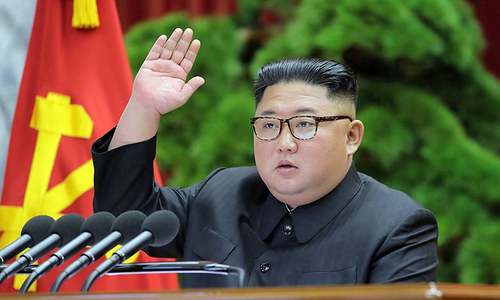
SEOUL: In a black fur hat and clutching binoculars, North Korean leader Kim Jong Un oversaw his latest firing drill, a move Seoul said on Tuesday aimed at drawing the attention of the US and South Korea.
Kim “guided another firepower strike drill of long-range artillery”, the North’s KCNA news agency reported, a day after Japan said Pyongyang had fired what appeared to be ballistic missiles.
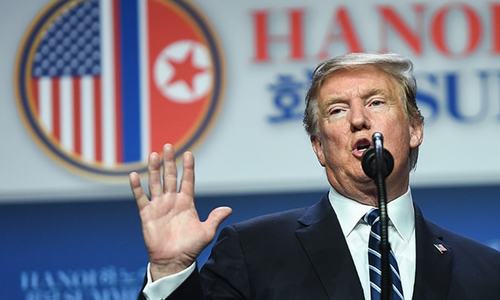
The North has been continuing to refine its weapons capabilities, analysts say, more than a year after a Hanoi summit between Kim and US President Donald Trump broke down.
Images carried by official Rodong Sinmun newspaper showed rockets blasting out of multiple launchers each with four firing tubes, striking what appeared to be an island target.
Other pictures showed smaller-calibre projectiles and artillery shooting salvos of rounds.
Kim, wearing a Russian-style hat and a khaki military jacket, watched from a trench next to an officer in a black facemask.
Pyongyang has closed its borders and imposed strict conditions as it seeks to avoid the worldwide coronavirus outbreak.
The three joint firing drills Kim has supervised in the last fortnight were his first military-related activity this year, Seoul’s unification ministry said.
“It is for strengthening internal solidarity and externally, attracting the attention of the US and South Korea and pressuring their change in attitude,” it added in a statement.
North Korea is under multiple sets of United Nations, US and other sanctions over its weapons programmes.
Washington and Pyongyang talks have been deadlocked since Hanoi over sanctions relief and what North Korea would be willing to give up in return, and a high-profile meeting between Trump and Kim failed to break the logjam.
Pyongyang set Washington a unilateral end-2019 deadline to offer fresh concessions, and in late December Kim declared the North no longer considered itself bound by its moratoriums on nuclear and intercontinental ballistic missile tests.
He also threatened a demonstration of a “new strategic weapon” soon.
The North carried out a series of weapons tests late last year, the last of them in November, which it often described as multiple launch rocket systems although others called them ballistic missiles.
It also conducted static engine tests, most recently in December. The report by Pyongyang's Korean Central News Agency came a day after South Korea's military detected the launches of three short-range projectiles off the North’s eastern coast.
KCNA said Kim showed great satisfaction as his front-line artillery units demonstrated excellent marksmanship during the exercise that tested their abilities to execute quick counterattacks.
The KCNA said Kim set vowed to build his artillery force into the world’s strongest arms of service everyone is afraid of but did not mention any direct comments toward the United States or rival South Korea.
Seoul’s Joint Chiefs of Staff said the projectiles fired from the eastern coastal town of Sondok flew as far as 200 kilometres at a maximum altitude of 50 kilometres (30 miles) before landing in the waters between the Korean Peninsula and Japan.
Kim also oversaw artillery exercises on Feb 28 and March 2 as the country resumed weapons tests for the first time since November, a lull that some experts say could have been caused by the country’s toughened preventive measures to fend off COVID-19.
North Korea has not publicly confirmed a single case of the illness, but its state media have reported that thousands of people have been quarantined as part of strict prevention measures.
Kim had entered the new year vowing to bolster his nuclear deterrent in face of gangster-like US sanctions and pressure.
Nuclear talks have stalemated since the collapse of the second summit between Kim and US President Donald Trump in early 2019 when the Americans rejected North Korean demands for major sanctions relief in exchange for a partial surrender of its nuclear capabilities.
Published in Dawn, March 11th, 2020