Verdicts in 2 terror financing cases against Hafiz Saeed to be announced on Feb 8


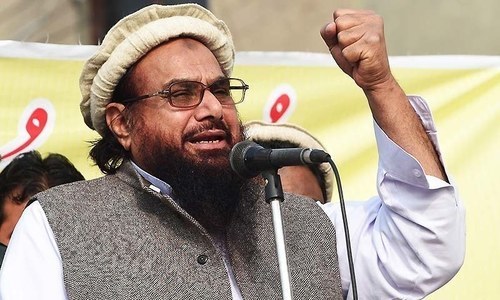
An Anti-Terrorism Court (ATC) in Lahore on Thursday reserved its verdicts in two cases pertaining to terror financing against Hafiz Saeed, chief of the proscribed Jamaatud Dawa (JuD).
ATC judge Arshad Hussain Bhatta will announce the verdicts in both cases on February 8.
The cases were filed by the Counter-Terrorism Department's (CTD) Lahore and Gujranwala chapters. The case filed by CTD's Gujranwala chapter was initially being heard in a Gujranwala ATC but was shifted to Lahore on the directions of the Lahore High Court.
During the trial of both cases, the court recorded the statements of 23 witnesses.
The JuD chief was arrested by CTD in July last year, while he was travelling from Lahore to Gujranwala. Prior to his arrest, 23 first information reports had been registered against JuD leaders, including Saeed and JuD Naib Emir Abdul Rehman Makki, at CTD police stations of Lahore, Gujranwala, Multan, Faisalabad and Sargodha in July 2019.
According to the CTD, JuD was financing terrorism from the massive funds collected through non-profit organisations and trusts including Al-Anfaal Trust, Dawatul Irshad Trust, Muaz Bin Jabal Trust, etc. These non-profit organisations were banned in April last year as the CTD, during detailed investigations, found that they had links with the JuD and its top leadership.
Saeed is nominated in about 29 cases pertaining to terror financing, money laundering as well as illegal land grabbing.
Curbing terror financing
In February last year, Paris-based Financial Action Task Force (FATF) had warned Pakistan to deliver on its commitments to curb terror financing and money laundering.
Risks to the global financial system have virtually put the country’s entire machinery into an aggressive mode to show tangible progress within two months of the warning.
While the meetings were taking place, the government had announced a ban on JuD and Falah-e-Insanyat Foundation (FIF) to partially address the concerns raised by India that Pakistan supported these and six similar organisations, including Jaish-e-Mohammad (JeM) or at least considered them low-risk entities.
Law enforcement agencies over the next few weeks had intensified their crackdown on JeM, JuD, FIF and other banned outfits, and arrested more than 100 activists. Nearly 200 seminaries besides hundreds of other facilities and assets associated with them across the country were taken over by the government.
Quarterly assessments by the FATF of Pakistan's progress continued over the course of the year.
In the latest FATF review held in October 2019, it was found that while Pakistan has made significant improvements, it will have to take "extra measures" for "complete" elimination of terror financing and money laundering. A reprieve until February has been given until when Pakistan will remain on the task force's "grey list".
In 2012, Pakistan was placed on the grey list and remained on it till 2015. The country was put on the list again on June 29, 2018. Pakistan was given 15 months for implementation of the 27-point action plan, with a warning that in case of failure the country would be added to the blacklist — a list of the countries branded as uncooperative and tax havens for terror funding.