THE World Economic Forum, the annual high-profile summit of the world’s high and mighty in Davos, Switzerland, concludes this weekend after serial back-slapping, shedding of crocodile tears for the ‘less privileged’ and vague promises to tackle climate change.
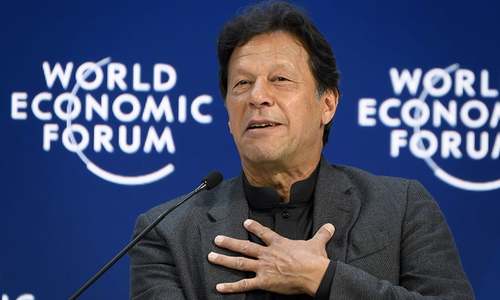
Leading the Pakistani delegation in Davos, Prime Minister Imran Khan was seen in a number of made-for-television exchange of pleasantries with US President Donald Trump and executives of major MNCs such as YouTube and Facebook. The idea was to sell Pakistan as an attractive venue for investment by big business.
As this humdrum PR exercise was playing out, a war of words was taking place back home in Islamabad between Chinese and US diplomats. The subject of dispute was CPEC. US State Department representative Alice Wells warned that Chinese aid would not guarantee Pakistan a more prosperous future, and portended dependency and despair instead.
The irony of American officials warning Pakistan about the perils of accepting conditional aid from a superpower cannot be lost on even those with a cursory understanding of Pakistan’s political economy. After all, we have been on Washington’s payroll since at least 1954, and Trump has once again kick-started military aid that had stalled somewhat under Obama. All told, Pakistan’s national security state would not have taken on the shape and form that it has without Washington’s patronage.
It scarcely matters whether the patron is the US or China.
For its part, Beijing says that it is enhancing the ‘development’ agenda in Pakistan, singularly focused on building roads, power plants and industrial parks. Chinese money, it is suggested, will trigger productivity and growth which will benefit Pakistanis in a way that Western aid packages have never stimulated.
Beijing is as motivated by its strategic concerns as Washington, irrespective of the significant differences in forms of aid that either superpower offers Pakistan. Time will tell whether China’s beneficence produces qualitatively distinct outcomes for Pakistan’s working people and ethnic peripheries than that of America, the IMF, World Bank or other Western donors, but rest assured China is not giving us a freebie.
What I want to emphasise — and this also relates to Davos and the global political economy — is that our fundamental posture with regards to generating strategic rents from external patrons has remained unchanged. In this sense alone, it scarcely matters whether the patron is the US, China, IMF, Saudi Arabia, Qatar or any other country /entity, because economic decision-making is dictated by the interests of a parasitic establishment rather than the welfare of our 220 million people.
Indeed, this is the story of many ‘underdeveloped’ countries, including those, like us, that are well endowed with natural resources and youthful populations that could form the basis of relatively more autonomous, equitable and ecologically sustainable models of development.
Since the mythical narrative of ‘globalisation’ was mainstreamed after the end of the Cold War some 30 years ago, economic ‘experts’ have drilled into our minds a one-size-fits-all logic of growth and development based on opening up the economy to global finance, eliminating any and all regulatory controls on the exploitation of cheap labour and natural resources, and creating a captive public that borrows money from financial institutions to fund conspicuous consumption.
In academia and within critical journalism, it is now common knowledge that this model of ‘development’ has exacerbated inequality, pushed the planet to the verge of climate breakdown, and made both territorially bounded and the global economies more volatile.
Yet the elephant in the room remains unnamed at gatherings like Davos, just as is the case in Pakistani officialdom. The rent-a-state logic that has guided our thinking about ‘development’, and those of other historically imperialised zones of the capitalist world-system refuses to go away. Why would it? Those who have benefited from this logic don’t want it to change.
So on the one hand, the rhetoric about globalisation and development persists when the global ruling class converges, while on the other, the same leaders go home and spew hateful political slogans that create a binary between a mythical unitary nation and its proverbial enemies. With each passing day, class privilege within societies and across the globe worsens, planetary destruction becomes more imminent, wars and violence proliferate, and almost eight billion people become ever more alienated, from their own selves and one another.
Chinese and US banter aside, promises of YouTube and Facebook investment in Pakistan notwithstanding, we — in Pakistan and much of the world — are being force-fed the same old, stale recipes for ‘development’ that have been on tap for decades.
The only thing that has changed is that the time for intellectual and political resistance to rent-a-state policies is running out.
The writer teaches at Quaid-i-Azam University, Islamabad.
Published in Dawn, January 24th, 2020