IT will soon overtake China as the most populated country on the planet. It is home to arguably the world’s most diverse and oldest human civilisation. The so-called ‘crown jewel’ of the British Empire, the European-dominated world system would not have come into existence without its people and resources. Today, it represents one of the major pillars of the global capitalist order.
And it is burning.
India, Pakistan’s alter ego, stands at a crossroads. In contrast to Pakistan, the modern Indian polity has been formally structured around the notion that the subcontinent is a rainbow of infinite colours, all of which are equal to any other. However contradicted it may have been, the idea of India as a secular republic has remained dominant for decades, both within officialdom and society at large.
Until now.
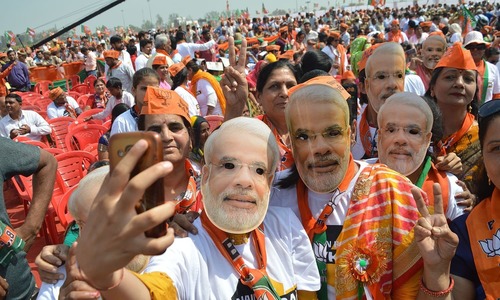
I need not go over what most informed observers already know about the RSS, BJP and the political project known as Hindutva. It is now more than just an aspiration to create a majoritarian tyranny; over the past three decades it has remade the body politic and the Modi government is now rewriting history in a way reminiscent of what the Zia regime did on this side of the border in the 1980s.
Where some fires cause despair, others are reason for hope.
But there is something else going on in India today, with which only those Pakistanis willing and able to transcend their own state’s narrow nationalism can make common cause. India is burning, yes, but where some fires cause despair, others are reason for hope.
Read: From India to Bharat
Like Pakistan, India is in the throes of a demographic revolution. The majority of its 1.3 billion people are young, and it is in the belly of this rumbling beast of youthful aspiration and a political-economic system that is ultimately incapable of generating anything but despair, that the battle for India will be fought and won in years to come. In this sense alone, the similarities between contemporary India and Pakistan are striking.
Many of India’s hundreds of millions of young people, increasingly urban and well-informed, like those everywhere across the globe, have grown up believing the hype about globalisation, and particularly the unparalleled and unending riches that await them in ever-liberalising India.
But the globalisation ‘miracle’ has unravelled rapidly over the past decade, first in the Euro-American heartlands of capitalism, and increasingly in the rest of the world too. The almost mythical software industry centred in Bangalore is not growing so fast anymore, and more generally there are simply not enough jobs to absorb the approximately 20m young Indians who enter the job market annually.
Modi counted younger, tech-savvy generations as amongst its primary supporters. With the economy stagnating, the prime minister has resorted to the Hindutva card in more brazen fashion to placate restive youth, and, as the recent attacks on JNU and other universities illustrate, given them licence to vent their frustrations by targeting the ‘anti-national’ elements that stand in the way of the Hindu Rashtra.
Yet there are also frustrated and politicised young people on the other side of the contemporary divide in India, and the unprecedented mobilisations of the past couple of weeks confirm that their numbers are refreshingly large. The mass opposition to the Citizenship Amendment Act has been spearheaded by these young people — and this includes people of all religious faiths, not just Muslims, as many in Pakistan might like to believe.
Importantly, the vision of India — and the world — propagated by this segment of the youth is not just limited to fairy-tale notions of cultural harmony and India as a mythical unity. It also gives primacy to working classes and menial castes, women and other oppressed genders, and Nature herself, explicitly challenging the logic of capital that neither Modi nor any other self-proclaimed leader of ‘the people’ in the current conjuncture is even willing to name.
This past Wednesday (Jan 8) a reported 250m Indians brought the entire country to a halt through a peaceful general strike. It was a massive show of strength to complement the brave resistance to fascist goons in the country’s major universities. It shows that the legacies of the anti-colonial freedom movement and the popular left mobilisations of the 1960s and 1970s are alive and well, brought to life again by a new generation with its own organic understandings of state and society and with a will to change them.
Rather than look on with glee at India’s internal strife, fall into a typical lament for the plight of Muslims, or adopt any other passive-aggressive position, the situation across the border should compel us to action, to build bridges. If this emergent generation of young progressives in India, Pakistan and beyond come together, there is a chance yet that the universal principles they espouse can become a practicable, political reality, that future generations can save themselves and the planet from hate, war and, ultimately, total destruction.
The writer teaches at Quaid-i-Azam University, Islamabad.
Published in Dawn, January 10th, 2020