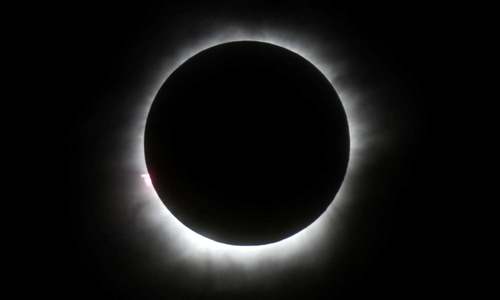
‘Ring of Fire’ solar eclipse to darken skies today


 0
0


KARACHI: An annular solar eclipse, said to be the last big celestial event of the year as it comes to a close, will occur on Thursday morning.
Starting at 7.30am (PST), it is to peak at 8.37am and go on till 1.06pm. The eclipse will be visible all over Pakistan, especially in Karachi and Gwadar, according to the Pakistan Meteorological Department.
It said the celestial event will be visible in eastern Europe, northern and western Australia, eastern Africa, Pacific Ocean and Indian Ocean, and much of Asia, including Pakistan.

The solar eclipse is not a total eclipse but an annular one. This means the sun and the moon will be positioned in a way to form a “ring of fire” as the moon won’t be able to completely cover the sun. Hence its edges will be illuminated.
The rare and historic event will be completely different from the total solar eclipse that took place in August 1999 due to the ‘albedo effect’. It means that most of the radiation did not reach the ground and got deflected back into space because of cloudy skies. But this time there will be a clear sky. Therefore, there will be a direct impact of the radiation. Hence, people have been advised not to look at the sun with the naked eye during the eclipse as it may cause permanent eye damage or even blindness.
Superstitions, beliefs
Also there are several superstitions being associated with the celestial event. Some say it may bring about major changes in world politics with shifts in power. In the case of Pakistan, it may be remembered that the government fell within two months after 1999 solar eclipse.
Other beliefs include thoughts of fear. In ancient China, people used to counter the effects of a solar eclipse by getting together and screaming aloud. They believed that there was a big snake eating up the moon which needed to be stopped and scared away with the noise.
Also some believe expectant mothers should not go out when there is a solar eclipse and to stay away from sharp objects. Pregnant animals such as livestock, too, are brought indoors at such times.
There is also a belief that there are stage germs unleashed during a solar eclipse so all eatables are also kept covered or in the fridge.
Some countries announce a public holiday on such occasions.
People associate life and death with solar eclipses and therefore they offer additional prayers at this time. They may also sacrifice animals or give a little extra to charity. Special or ‘Kusoof’ prayers, as they are called, are also said in mosques of Pakistan and other Islamic countries.
Published in Dawn, December 26th, 2019