Punjab govt sets up body to decide about Nawaz stay

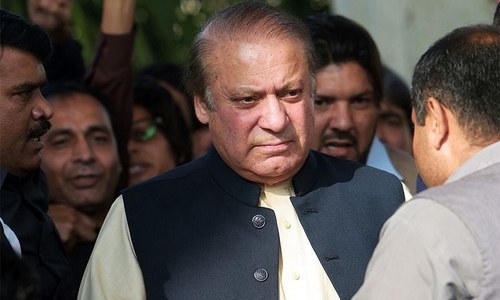
LAHORE: The Punjab government has constituted a four-member committee to decide the request of former prime minister Nawaz Sharif who sought to prolong his stay abroad for his medical treatment, claiming his condition to be ‘very critical’.
Mr Sharif has written to the Punjab home secretary seeking extension in his stay abroad for his medical treatment (not limited to a specific period) following the end of his four-week permission for the purpose.
The provincial government constituted a four-member committee headed by Law Minister Mohammad Basharat Raja to look into the matter, a source told Dawn.
Mr Basharat was not available for a comment.
The ex-premier had left for London over a month ago after the Pakistan Tehreek-i-Insaf government gave him a one-time permission to travel abroad for medical treatment during his bail period of four weeks without the condition of submitting indemnity bonds. The Islamabad High Court had directed Mr Sharif to seek Punjab government’s permission for further relief if required.
Ex-PM writes to home secretary seeking to prolong his stay abroad for medical treatment
It declared that until the provincial government decided the matter, the bail would remain in effect and the court order would cease to exist if the government decided against extending the bail period.
Pakistan Muslim League-Nawaz President Shahbaz Sharif had submitted an undertaking in the Lahore High Court (LHC) promising return of his elder brother Nawaz Sharif within four weeks or as and when “certified by the doctors that he has regained his health and is fit to return to Pakistan”.
He had also undertaken to provide periodical reports of the doctors, duly certified by Pakistan’s embassy in London, to the registrar of the LHC. The undertaking includes a clause that states that the Pakistan High Commission will have the right to meet Nawaz’s doctors to ‘verify or confirm about his health’, if at any stage the federal government has credible information that the former premier was living abroad despite being fit to travel.
Citing his past record to face the process of law and justice, the ex-PM, in his undertaking, had also pledged to return within four weeks or as soon as he was declared healthy and fit to travel back. “I also do hereby bind myself to the undertaking given by my brother Shahbaz Sharif.”
The interior ministry’s notification had also mentioned the LHC judgement about the travel permission. The LHC had allowed his stay in any other country for four weeks for medical treatment, observing that the duration could be extended based on his medical reports.
Mr Nawaz, who was diagnosed with an immune system disorder, had been advised by doctors to go abroad for medical treatment. His personal physician Dr Adnan had recently told the media that he had been diagnosed with a complicated coronary disease and would undergo further scans before doctors began treatment.
In a tweet a few days ago, Dr Adnan said: “Former PM #NawazSharif underwent comprehensive Cardiovascular evaluation & investigations at Royal Brompton & Harefield Hospital, London. He’s diagnosed with complicated Coronary Artery/Ischemic Heart Disease with significant disease burden. Cardiac Perfusion Scans scheduled.”
Published in Dawn, December 25th, 2019