Khyber Pakhtunkhwa slashes current spending by Rs95 billion


PESHAWAR: The Khyber Pakhtunkhwa government has cut down its ever-growing current expenditure bill by Rs95 billion from the initial projection of Rs552 billion to Rs452 billion in the current financial year.
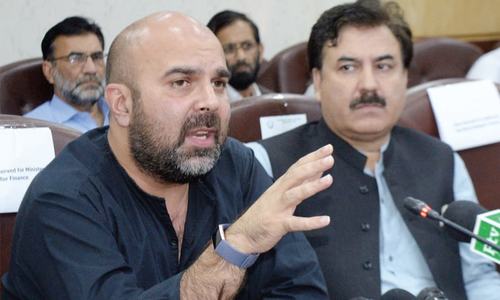
Finance minister Taimur Saleem Jhagra told reporters here that the government through financial reforms, cost cutting and reduction of the throw-forward liability size had made more funds available for development.
He said the province’s pay and pension bill was increasing faster than the budget capacity.
Mr Jhagra said the province’s pay and pension bill had increased from Rs87 billion in 2010-11 to Rs314 billion in 2018-19.
He said the upgradation of a large number of posts, regularisation of project staff and granting of special allowances to several cadres during the last five years had cost the provincial government Rs26 billion annually.
Minister says more funds available for development due to financial reforms
“These measures, which were departure from business as usual, had cost the exchequer Rs26 billion a year,” he said.
The minister said the major chunk of Rs11.3 billion had gone to the upgradation of 263,174 posts.
He also said the regularisation of thousands of project employees cost the province Rs5.3 billion, health professional allowance Rs8.5 billion, executive allowance for civil servants Rs0.5 billion and technical allowance for engineers Rs0.1 billion.
Mr Jhagra said the province’ throw-forward liability, the development expenses that couldn’t be made in the current year and were budgeted to be met in later years based on average of allocations, had also grown steadily leaving little space for development.
He said the throw-forward liability had increased from Rs34 billion in 2012-13 to Rs469 billion in 2018-19.
The minister said the median allocation had also reduced from 25 per cent of the project value in 2012-13 to only eight per cent of the project value in 2018-19.
He said the current government in its first year had cut down the throw-forward liability from Rs469 billion to Rs420 billion increasing the development budget to Rs107 billion.
Mr Jhagra said a presentation made in Dec 2018 had pitched the size of the province’s development outlay along with district annual development programme at Rs57 billion.
He said to increase development space, the government increased the retirement age from 60 years to 63 years and thus, saving Rs20 billion a year.
The minister said the limit for early retirement age had been increased from 45 years to 55 years.
He said when a teacher retired at the age of 45 years and began getting pension, he began another job at the same time.
“Now, you are paying pension to a person who is in the prime of his life and doing a job as well,” he said, adding that the increase in early retirement age is saving the province Rs13 billion a year.
Mr Jhagra said the government also cut down over 1,000 projects to reduce the size of throw-forward liability.
He said the throw-forward liability was cut down by Rs203 billion, creating a space for Rs159 billion development projects.
“The throw-forward liability duration reduced from six years to 3.8 years, while the allocation for projects increased from eight per cent to 25 per cent,” he said.
The minister said due to those measures, tourism, youths and sports budget increased by 100 per cent, urban development’s by 67 per cent, agriculture’s 63 per cent, science and technology’s 62 per cent, and higher education and industries’ by 40 per cent each.
He said the size of development budget had increased following the 18th Constitutional Amendment as the money from the centre poured in.
Mr Jhagra said in the last five years, the provincial government focused on governance and social sector reforms like health, education and police and it was focusing on financial reforms.
He said the government had also approved an ADP policy, which had taken away the chief minister’s discretionary powers.
The minister said under the new release policy, 100 per cent of budgeted allocations for works sector, including roads, irrigation and public health engineering would be released including 95 high provincial priority projects.
He said in addition to all remaining departments, 50 per cent releases would be made for all approved projects covering funding for second and third quarters.
He said the government had also adopted a model of tracking revenue and expenditure.
Published in Dawn, December 10th, 2019