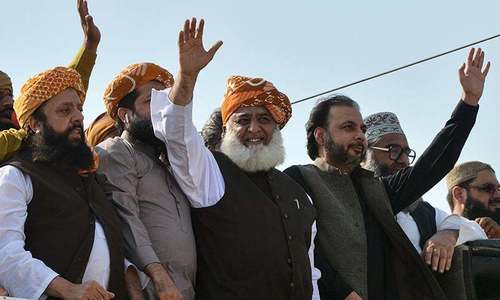
IT is not only JUI-F chief Maulana Fazlur Rehman who should be looking for an early exit from the current difficult situation. Opposition parties, the government, and indeed the country as a whole, must quickly emerge from this cloud of uncertainty that threatens to affect proceedings in many important areas.
Everyone with a stake in the democratic system must help the maulana and his party find an honourable route back home — especially at a time when the JUI-F’s demand for the resignation of Prime Minister Imran Khan is too unrealistic to deserve serious consideration.
Those opposition leaders flanking the maulana in selective moments appear to understand how impossible the demand is. They — the politicians of the PPP and PML-N — have both a sizeable presence in parliament and sufficient interest to keep the current elected assemblies functioning.
Perhaps it would have been to everyone’s benefit had the JUI-F chief, a veteran politician otherwise difficult to dislodge from his Dera Ismail Khan constituency, managed to retain his seat in the National Assembly in the 2018 election. In such an event, it would have been easier for the well-wishers of democracy in Pakistan to advise a debate strictly inside parliament — especially at a time when the PTI government is barely into its second year.
That could not be, because, according to Maulana Fazlur Rehman, there were powers that saw to it that he lost the polls for the two seats he contested in 2018, his defeat serving as the fundamental reason for his protest.
The charged speakers on stage may have discussed a whole range of issues as the JUI-F march culminated in a sit-in threateningly close to the heart of power in Islamabad.
There is nothing that seems to have caused the protesters greater grievance than the perceived insult to their leader’s being ‘left out’ of parliament.
This puts greater responsibility on the maulana’s allies sitting in parliament to prevail over him when any extreme options to target the government come up for discussion at the opposition meetings. Together with the government camp and all other visible and invisible kingmakers, these opposition politicians have to somehow remind the dharna leader about his continued relevance to the system.
The federal religious affairs minister seemed to have briefly attempted this when, in a fleeting moment of common sense, he praised the JUI-F chief’s ability to bring such large numbers to the capital.
Chaudhry Shujaat Husain and Chaudhry Pervaiz Elahi are two other senior practitioners of the art of the possible who have tried to build a cordial channel with the leader of the protest — over and above all the nonsensical noise created by the PTI.
The latter party has not come out of its own dharna mode to carry out the basic chores associated with everyday governance, let alone dealing with an opposition sit-in.
Published in Dawn, November 7th, 2019