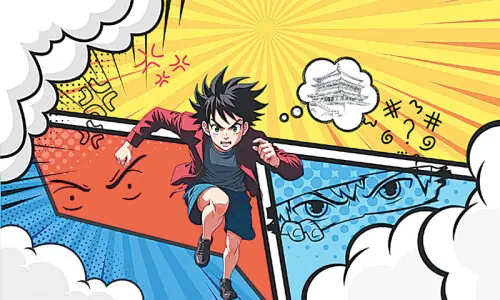

Our education system resembles a video game. If you win, you go to a next level and if you lose, you either exit the game or repeat classes. One gets defeated or passes a mission, just like exams. However, there is a difference between the two. Video games are highly entertaining compared to our school classes. Why, you ask? To find out, read on.
In our education system, a child whose brain is in the state of development is judged by how he scores in tests. If he scores low, he is considered stupid and worthless (indirectly of course), instead of being encouraged to do better.
How many times have you seen a teacher say, “You can do it” or “Never give up” on a test paper in which he failed. Instead, they only write “Keep it up” on high scores.
Why don’t they understand that the kid who failed his test today could turn out to be someone as smart as Steve Jobs who was a college drop-out or could become a Ronaldo who was terrible at school, but is now one of the highest-paid sportsmen in the world? How can one guarantee that a student who scores A grades only would get a highly-paid job? There are millions of toppers, but only one in a million becomes someone like Steve Jobs!
Our education system doesn’t care about individuality or dreams. It is all about shoving homework down students’ throats so that they don’t get time to achieve the dreams they want. Homework should be banned and self-study encouraged among students, which most of them probably won’t do because they are not interested and it has little to do with practical life. For instance, what is the purpose of subjects like trigonometry? How will it help me in practical life when I would be looking for a job as a writer or a chef?
So many students who want to become musicians or sportsmen are forced to study all subjects. Up to a level, it’s not a big problem as students must at least have the basic knowledge about all subjects, especially science and math. The problem occurs when students are forced to study a subject in so much depth that they have to pay money for extra tuitions for knowledge that he’ll probably forget in the next five years.
In addition, in school and colleges, there are only few paths that students can take they can only select science, arts or commerce groups. This grouping narrows the options for children by forcing them to take a group of subjects without giving them a chance to study and discover their aptitude for a wider range of subjects.
This often leads to students scoring low grades because they were not able to determine if they had the skills to study a subject when choosing it in grade eight or nine. And many miss out on getting a chance to know more about a subject they may be good at, for instance economics or accounts, because they choose the pre-medical group, or vice versa.
Most foreign education systems give students the chance to choose a mix of subjects based on their preferences. Students are also offered a chance to take on extra subjects in school and college board exams to give them a better and wider career choice.
Our studies are based on memory, which is why you don’t even feel a slight difference in your intellect after studying eight hours daily. They are making us hate education because of wrong teaching methods which is a great threat to us, as this is making students hate studies due to unbearable pressure and stress.
In the modern practical world, GPAs or grades are not important, what is important is our individual skill set and how one student is different from others. Individuality is taken away from us since our childhood at school.
My math teacher once said that humans are different from other creatures because humans have will power. This is indeed the truth, however, if I use all my will power trying to pass a math exam instead of chasing my dream of being an artist, it would be a waste of my time and energy.
The solution to rectify our education system is to change the current teaching methods, Students should be tested on their skill sets instead of their memorising skills.
Published in Dawn, Young World, November 2nd, 2019